Jas. T. Weeks, Rockville Centre, L.I.

weeks      weeks-seltzer

In 1883 James T. Weeks partnered with Capt. Thomas E Hawkins and together they manufactured and bottled soda and mineral water in Bayport, Long Island for twelve years under the name of Hawkins & Weeks.

In September, 1894 Weeks in an effort to pursue other interests, sold his share of the business to Hawkins. More on Hawkins & Weeks can be found in another post on this site.  Hawkins & Weeks

A feature on Weeks, published in the June 24, 1898 edition of the “Suffolk County News” picks up the story from there.

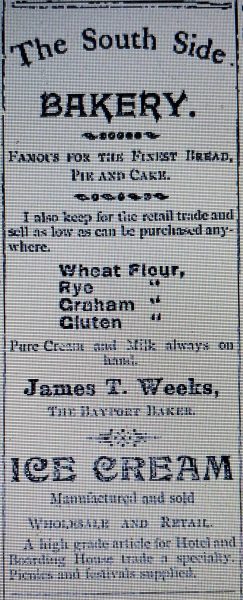
In the spring of 1895  James T Weeks, who had for a number of years been a member of the firm of Hawkins & Weeks engaged in the bottling business in Bayport, retired from the firm and established the South Side Bakery on Main Street in that village and also began the manufacture of ice cream on a large scale.

An advertisement for both the bakery and ice cream business appeared in the June 14, 1895 edition of the Suffolk County News.
The Feature on Weeks went on to say:

The bakery he disposed of the following year to Mr. Joseph Douglass but the ice cream business he retained. He removed his family to Rockville Centre where he is engaged in the business of bottling soda and mineral waters and has a large and growing trade.  He gives his personal attention to both establishments dividing his time between the places and his efforts to cater to the public are ably seconded by his estimable wife who resides in Bayport and has charge of the ice cream factory and of the parlors connected with it where ice cream, soda water, fancy cakes and confectionery are on sale.

The “Annual Report of the Factory Inspectors of the State of New York” in 1898 indicated that Weeks’ mineral water business had 3 employees during that time, all male (no address). The same report in 1903 showed water bottling at a Centre Avenue location in Rockville Centre (no employee information).

Up through the spring of 1909 Weeks maintained the bottling business in Rockville Centre while at the same time servicing communities as far away as Port Washington on Long Island’s north shore, a fact made clear by an advertisement found in the May 15, 1909 edition of the “Port Washington News.”

40 YEARS IN THE MINERAL WATER BUSINESS enables me to furnish you with the best article on the market. I manufacture and sell direct to the trade about everything in the line of soft drinks. My wagons pass through Port Washington weekly, and besides I have a delivery station there. Hotels and other business places supplied. Goods for picnics on short notice. All flavors of Soda and Seltzer Water constantly on hand.

JAMES T. WEEKS, Rockville Centre, L. I.

Six months later, on November 6, 1909, the same advertisement, in the same newspaper, located him, not in Rockville Centre, but in Mineola L. I., suggesting that he moved the business to Mineola sometime in the summer of 1909.

He remained in Mineola through at least 1912 after which I lose track, The business had apparently dissolved by 1920 when census records indicate Weeks was back  in Bayport, employed as a driver.

Based on this information, his bottling business was operational from roughly 1896 until sometime in mid to late 1910’s.

All the bottles I’ve found were mouth blown: two 27 oz with a tooled blob finish, several 8 oz tooled crowns and one siphon bottle. Haven’t seen a machine made bottle or one embossed with the Mineola location,, even on the Internet.

W & T, (Wills & Taylor) 57 Downing St., N.Y.

Soda water manufacturers, Wills & Taylor was listed in the New York City directories from 1864 to 1874.

The business was first listed in the 1859 NYC directory as Wills, Taylor & Co., with an address of 49 Greene Street. The 1862 NYC Copartnership and Corporation Directory listed three partners; William Wills, Anson B. Taylor and John Scanlan. Then, on February 20, 1864 the partnership was dissolved when Scanlon retired. At the same time a new partnership named Wills and Taylor was formed. The notice announcing this change was published in the February 24, 1864 edition of the “New York Daily Herald.”

The company remained at 49 Greene Street until the Spring of 1866 when they apparently had a new building constructed at 57 Downing Street. The company was settled in their new quarters and renting out unused portions of the building in May, 1866 as evidenced by this May 4th advertisement in the “New York Daily Herald.”

The company remained at 57 Downing Street up through 1874. Anson Taylor continued to be listed individually with the occupation “waters” through the early 1880’s with an address of 119 East 124th Street.

On a side note, Anson B Taylor played baseball for a pioneering baseball club called the Mutual Baseball Club. Organized in NYC in June 1857, they were named after Mutual Hook and Ladder Company #1. A book entitled “Baseball Founders: The Clubs, Players and Cities of the Northeast that Established the Game”provided the following brief biography of Taylor:

Anson B. Taylor was born in Connecticut around 1827. He played a few games for the Mutuels in 1858, then was a regular for the next three seasons. He had served as club treasurer while an active player and began a four year tenure as club president in 1861. Taylor, who was partner in a mineral water business, died in New York on June 2, 1884.

The bottle I found is an 8 oz pony with an applied blob top finish. It’s embossed “W&T” with the 57 Downing Street address so it most likely dates between 1866 and 1874.

Fred vonDohln & Son, 348 West 36th St., N.Y.

vondohlen

I have to believe that the name embossed on the bottle refers to a grocer named Fred vonDohlen and is miss-spelled as vonDohln on the bottle.

There is a Fred vonDohlen listed as a grocer in the 1897 Trow NYC Business Directory at the same address that’s embossed on the bottle, 348 W 36th Street. In fact, he was also listed in every NYC general directory I could find between 1876 and 1909 and always at that address. Interestingly enough the 1900 Directory (and only this Directory) lists him as Fred vonDohlen & Son (as embossed on the bottle) and lists him as water not grocer. All other directories list him as a grocer (and no & Son).

The 1900 census records recorded a Fred vonDohlen living at 348 W 36th Street so it appears that he operated a small grocery store and probably lived above or in the rear of the store. He had four sons, the oldest of which, Karl, listed his occupation as clerk. I assume he was the clerk in his father’s store and is the son referred to on the embossed bottle. The other three sons listed unrelated occupations.

Looks like he was in business from at least 1876 to 1909. He could have been in the bottling business that whole time as well or maybe he gave it a go with his son for a year and it didn’t work out?

The current building at 348 W 36th St was built in 1936 so it doesn’t date back to the time frame of the business. The adjacent building is older and may go back that far.

The bottle I found has a tooled blob finish (8 oz) that probably dates to the  latter half of the business time frame, including  1900, the year he was listed in the water business. I’ve yet to see one of these bottles anywhere on the Internet.

United Bottling Co., P. F. O’Neill, 508 Greenwich St., New York


P. F. O’Neill was a bottler and soda water manufacturer located in New York City’s Lower Manhattan for almost 40 years. According to the 1900 census records, he was born in Ireland in 1859 and immigrated to the United States in 1876. It appears that he acquired the bottling business of James C. Kelly in 1885.

Kelly was listed in the NYC directories beginning in the mid-1860’s with the occupation “liquors.” Over the next fifteen years he was listed at 37 Front Street (1864 to 1866), 395 Washington Street (1866 to 1869) and 342-350 Greenwich Street (1868 to 1882) before landing at 185 Franklin Street in 1882. A publication entitled: New York’s Great Industries, published in 1884, featured Kelly’s business.

United Bottling Co., James Kelly, No. 185 Franklin Street – The bottling of ale, porter and other liquors forms a very important branch of industry in New York, and those engaged in the trade are among the most enterprising of our merchants. A prominent house engaged in this trade is that of Mr. James Kelly, who established this business many years ago, and has since conducted it with an annually increasing success. The large demand for non-intoxicating drinks has led to the foundation of numerous factories which produce many varieties of aerated and mineral beverages, such as soda, seltzer and vichy, and others too numerous to mention. Mr. Kelly makes a specialty of the above named articles, and likewise keeps always in stock a splendid assortment of London and Dublin porter, Bass ale, lager beer of the best brands for shipping and home trade. The trade of this house extends throughout the city and its vicinity. Mr. Kelly is highly esteemed in social and commercial circles for his unswerving honor and strict integrity, and has always been an earnest advocate and supporter of any movement which has been advanced for the benefit and welfare of his fellow citizens.

On June 22, 1885 “The New York Sun” reported that Kelly was in a severe accident.

Thrown From a Wagon on Seventh Avenue

While James C. Kelly of 185 Franklin Street was driving on upper Seventh Avenue yesterday his wagon was upset. Mr. Kelly was thrown out and severely injured.

Kelly did not recover from his injuries with his death notice appearing in “The New York Sun” two days later.

As early as 1886/1887 Paul F. O’Neill was listed as a “bottler,” at 185 Franklin Street, suggesting that O’Neill acquired the business after Kelly’s death. As early as September 1, 1883, the “City Record” listed  O’Neill with the occupation “mineral waters” at the 185 Franklin St address, so it’s likely O’Neill was associated with or at least working with Kelly at the time of his death.

O’Neill began listing the United Bottling Co. as a registered trade name in the 1890 Copartnership and Corporation Directory. That year the business was listed as: “United Bottling Co. (Paul F. O’Neill, propr.) 185 Franklin St.” However, it’s clear from the above feature that Kelly was using the United Bottling Co. name as early as 1884 and likely earlier.

In the 1891 NYC General Directory, O’Neill’s address changed to 508 Greenwich St. A relatively small operation, the “Annual Report on Factory Inspections” in New York State for 1898 listed the business with 5 male employees.

Sometime after 1927 O’Neill changed his address to 74 Varick St where he was listed as a soda water manufacturer in the 1931 and 1932 commercial directories. In 1933 he was still listed at 74 Varick Street but under the occupation of real estate.

Today 508 Greenwich is a four-story walk-up with a bar/restaurant at street level and an ornate exterior fire escape.

“Street Easy.com” says it was built in 1900 but O’Neill was using it as his address continuously since 1891. I assume that the 1900 date was probably the construction date of an addition. It must have housed the business.

The bottle I found is a tooled blob (8 oz) embossed with the 508 Greenwich Street address dating it no earlier than 1891. I’ve seen 2 different variants of this bottle on the Internet and this appears to be the newer version, so I’d say it  likely dates to the early 1900’s.

Although the business extended into the early-1930’s, I’ve not yet seen an example of a tooled crown finish or machine made bottle associated with this business.

This post was updated on April 20, 2012 and again on April 6, 2025 to include the information on James C. Kelly’s business. Thanks to Niall, a reader of the original post, who informed me of the connection between O’Neill and Kelly.

E D Seabury, Rockville Centre, L.I.

seabury-2

The E stands for Edwin D Seabury. A long-time Long Island resident, his obituary, found in the September 29, 1926 edition of the “Nassau Daily Review,” described him as:

one of Long Island’s most prominent figures and a leader in political, educational, business and fraternal circles…

His obituary went on to say:

Mr. Seabury was born at Greenpoint, Long Island City. He was in the piano hammer manufacturing business before moving to Rockville Centre in 1889. He established his business in Rockville Centre, became the first village trustee of this town and later held the office of village president, being the third in line to have this distinction. After residing in Rockville Centre for 18 years he moved to Yaphank…

His obituary located Seabury in Rockville Centre from roughly 1889 to 1907, a time frame  supported by advertisements found in several editions of the 1894 “American Art Journal.” The ads indicated Seabury operated his piano business out of Rockville Centre while at the same time he maintained a branch office on Second Avenue in New York City.

Furthermore, he’s also listed in the 1898 and 1900 Annual Report of Factory Inspections of the State of New York in Rockville Centre with the occupation “piano supplies.” The 1900 Report indicated that he had four employees.

During his time in Rockville Centre, or for that matter, his entire career, I can’t find any mention of a bottling business.

Acoording to another Seabury obituary, this one found in the September 29, 1926 edition of the “Brooklyn Daily Times,” he  ultimately settled in Roosevelt, Long Island in 1905 where he passed away in 1926.

The bottle is 27 oz with a tooled blob that fits the 1889 to 1907 time period that Seabury was active in Rockville Centre.

Carl Schultz CPMS (Central Park Mineral Springs), New York

schultz

Carl Schultz first began producing artificial mineral waters in 1862. At around this time, he met Thomas Walker who had invented the siphon bottle and they went into business together.

The business was initially called Schultz and Walker and was listed at 133 Fourth Avenue from 1864 to 1868 and 112 East 14th Street from 1868 to 1872. Around 1873 they began listing two addresses: 436 First Avenue and 860 Broadway and by 1877 they had dropped the Walker name and the business was renamed Carl H Schultz.

An full page advertisement in the 1876/1877 directory indicated that their factory was located at the First Avenue location. I assume that Broadway served as their retail location.

The factory remained at the First Avenue location through most of the 1920’s but it appears that their retail locations moved around. In the mid 1880’s they listed 76 University Place and a 1909 advertisement specified that orders be sent to 1129 Broadway.

Carl Schultz also operated a Mineral Springs Pavilion in Central Park at the north end of Sheep Meadow that opened in 1867.

schultz-cp-pavillion

An 1871 article in the New York Daily Herald described it this way:

THE MINERAL SPRINGS IN THE PARK

One of the most attractive features of the Park – in all things beautiful and attractive – is the Moresque structure that stands on a gently rising eminence within earshot of the Mall. It combines, with a rare picturesque of appearance, the attractive utility of furnishing to the thirsty pedestrian the very thing which on a hot and dusty day he looks around him to procure – namely, a drink at once refreshing, palatable and nonintoxicating. The Central Park mineral springs, under the care of Schultz and Walker, where all sorts of mineral waters are kept, make the feature of the Park, which all the visitors thereto feel bound to appreciate.

In addition to refreshment on a hot day, the mineral springs offered a cure for everything from indigestion to diabetes to rheumatism. According to a May 2, 1897 story in the New York Tribune:

Carl H. Schultz originated the plan of having in Central Park a place for the sale of mineral water to enable invalids to combine a mineral water cure with exercise in the open air. At the Springs the leading natural waters are kept on hand, and in addition there are the artificial waters, in the manufacture of which only distilled water is used. Many prefer the artificial mineral waters on account of their uniform composition, great effervescence and freedom from bacteria. Some of them contain more lithium carbonate than any natural lithia water contains. The following waters are recommended for invalids:

For indigestion – Carbonic water. For stomach, kidney and liver trouble – Double or quadruple Carlsbad, Marienbad, Kissingen. For catarrh – Obersalzbrunn, Seltzers, Kissingen. For diabetes – Ballin, double and quadruple Carlsbad. For gout and rheumatism – Lithia water, especially when mixed with Carlsbad or Vichy

If refreshment and mineral water cures were not enough, visits to the Mineral Springs could also reduce your weight.

Oh yes…and one more thing. It also made a good cocktail! “Why spoil wine and whiskey with inferior Mineral Water?”

schultz-ad

Carl Schultz died in 1897. The 1907, 1914 and 1919 Copartneship and Corporation Directories all list Rudolph and Walter Schultz as Directors of the Schultz Corporation, so it looks like the business remained in the family through at least 1919.

In 1929 The Schultz Corporation merged with Schoneberger and Noble (bottlers for the famous Dr. Brown’s Celery Tonic) and Brownie Corp. (makers of the Brownie Chocolate Drink) to form the American Beverage Corporation. Shortly afterwards the consolidated business opened a new plant in Brooklyn at 118 N 11th Street. An April 7, 1929 story in the Brooklyn Times Union announced the changes.

Concentration of the manufacturing operations of the American Beverage Corporation, which early this year acquired the Carl H. Schultz Corporation, Schoneberger & Noble, Inc., and the Brownie Corporation, all of New York, in a new plant in the Williamsburg section of Brooklyn, is announced by E. C. McCullough, president. One unit is now in operation, while the entire plant will be ready for the seasonal demand at the end of the month. ..

The new plant will provide manufacturing facilities for a gross business of $2,500,000 to $3,000,000 per year or about three times the volume done by the subsidiaries last year, while concentrating in one plant will materially reduce operating costs.

By the 1920’s the Central Park pavilion had become a soft drink and candy shop and in 1957 it was demolished. 440 First Avenue is within the current limits of the Bellevue Hospital complex and no longer exists.

I found two ten-pin soda bottles (8 oz) each with a tooled blob top finish. C-P-M-S (Central Park Mineral Springs) is embossed on both. I’ve also found a Dr. Brown’s Celry Tonic bottle embossed “One and Only One.”


H. Ressmeyer, 516 E 85th St., N.Y.

ressmeyer-1

Henry Ressmeyer was a German immigrant who, according to 1910 census records arrived in the United States in 1886. It appears that he got his start in the New York City bottling industry sometime around the turn of the century.

At that time the 1901 NYC Copartnership and Corporation Directory listed Henry Ressmeyer, along with Frederick Evers, as the proprietors of Evers and Ressmeyer, located at 987 Park Avenue. Both men were also listed individually as bottlers at the same address in NYC’s  general directory. They remained listed that way through 1904.

In 1906, the firm of Evers and Ressmeyer disappeared from the directories and Ressmeyer was listed individually as a bottler located at 234 East 84th Street. So it appears that Evers and Ressmeyer went their separate ways around that time. Shortly afterwards Ressmeyer moved both his business and residence to 514-516 East 85th Street, where he remained well into the 1930’s.

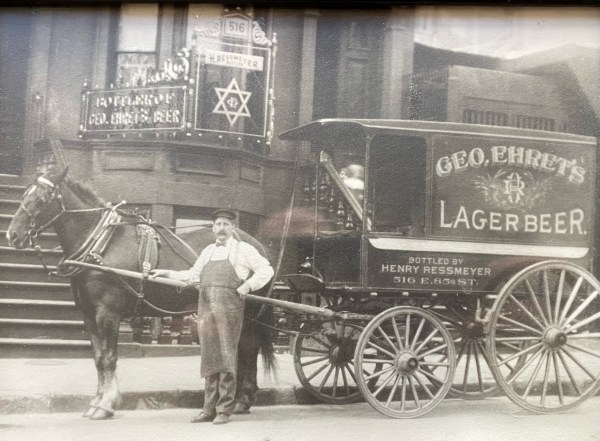
A bottler for the George Ehret Brewery, here he’s pictured with his wagon outside his 516 East 85th Street location.

Ressmeyer’s eldest son, John Frederick, apparently joined his father in business sometime  in the mid to late teens, changing the name of the business to Henry Ressmeyer & Son. (The 1920 census records listed both father and his 19 year old son’s occupation as “bottler.”)

At some point, the company also served as distributors for the Jacob Ruppert Brewery, as evidenced by the following advertising sign. Both the Ehret and Ruppert breweries were located within several blocks of Ressmeyer’s business so it makes sense that he was associated with them.

The company remained in business during Prohibition, listed in the early 1930’s under the heading “bottlers of cereal and fruit beverages.”

It’s not clear if the company survived into the 1940’s. By then, census records from 1940 listed Henry Ressmeyer as the superintendent of an apartment house, living in the Bronx. John Frederick was still in the bottling business but included his occupation as simply “salesman.”

Today, 514 and 516 E 85th Street no longer exist. They have been replaced by a large apartment building at 510 E 85th St.

The bottle has the 516 E 85th Street address embossed on it dating it no earlier than 1908-1909 when the business moved to that location. It’s a champagne style beer with a tooled blob finish so it wasn’t manufactured too long after the move.

The great grandaughter of Henry Ressmeyer contacted me after reading the initial version of this post and was able to provide the photograph of Henry Ressmeyer next to his wagon, as well as the Jacob Ruppert beer sign both of which are now included in the post…Thanks Erika!

Pflug & Ackley, Hempstead, L.I.


The founders of Pflug & Ackley were Daniel Pflug and Henry E. Ackley. Pflug was a German immigrant who arrived in the United States in 1880. Ackley was born in Lynbrook, New York and was a life-long Long Islander.

The company was apparently established in 1881. At that time, a news item published in the April 22, 1881 edition of the Roslyn (L. l.) News stated that Ackley had partnered with Pflug after leaving the bottling business of Elbert Matthews.

Alfred Matthews, former Keeper of the Town Poor House, has entered into partnership with Elbert Matthews in the lager beer and soda water business. Henry Ackley, foreman in Elbert Matthew’s establishment has entered into partnership with Pflug of Washington Square, in the same business. They have leased the Mearing building on Greenwich Street and moved it flush with the pavement.

The Hempstead section of the 1890 Lain’s Business Directory listed their address as 33 Greenwich. They would remain at that location as late as the early 1950’s.

In early advertisements, like this one published in the September 4, 1886 edition of the Roslyn News, they also referred to the operation as the Enterprise Bottling Company.

Apparently a small operation, the “Annual Report of the Factory Inspectors of the State of New York in both 1899 and 1900 indicated the business had 6 employees during that time, all male.

Primarily a bottling operation, in the early years they also manufactured something called steamed beer, as evidenced by this June 22, 1889 item in the Roslyn News.

Pflug & Ackley of Hempstead, have added a steam engine to their bottling facilities. They are now prepared tp furnish parties promptly with their well-known steamed beer.

Later that year their steamed beer (two kinds?) was included in this October 12, 1889 Roslyn News advertisement.

According to Ackley’s obituary (provided by a family member who read an earlier version of this post), Pflug retired in 1903 and Ackley continued the business until 1909 when his two sons, William H. and Valentine assumed control.

A 1914 advertisement that appeared in several summertime editions of the Nassau Post indicated that by that time, in addition to mineral water and beer, the company was also bottling wine and liquors.

The same 1914 advertisement also included this photograph of their “Bottling Department and Sales Rooms in Hempstead L.I.”

An article under the Headline “Makes Good Beverages” in the December 17, 1925 edition of the Hempstead Sentinel provided a snapshot of the business at that time.

One of the oldest established firms in Hempstead is the Pflug and Ackley bottling works at the corner of Greenwich and Prospect Streets. The name has been synonymous with good beverages extending over nearly three generations. At the present time the business is managed by William H Ackley, who has a reputation for progressiveness.

Mr. Ackley keeps pace with all the newest methods, particularly those for the manufacture of the purest of products under the best sanitary conditions. He has recently installed machinery that has done away with much of the labor of human hands.

Mr. Ackley reports that although he is daily securing a large quantity of cider for the holidays there is such a demand for it that his delivery trucks are kept busy filling the orders of customers.

There was a P&A advertisement in the same December 17,1925 issue of the Hempstead Sentinel for Russet Apple Cider.

pa-ad

During the 1920’s the company was serving as the local Nassau County bottler for Ward’s “Orange (and Lemon) Crush as evidenced by a series of 1920 Brooklyn Daily Eagle” advertisements.

An August 16, 1929 advertisement in the Nassau Daily Review indicated that they served in a similar position for Schwepp’s Beverages as well. In fact, according to an August 11, 1933 advertisement in the Nassau Daily Review, by then they were handling “160 different items as distributors of various beverages.”

By the mid-1930’s the company had apparently changed its name to the Ackley Beverage Company. I’ve found shards of a bottle embossed Ackley Beverage Co, Hempstead, N. Y., that includes a 1938 embossed date, so the name change had certainly occurred by then.

Newspaper references to the Ackley Beverage bowling team indicate that the business was still active in the early 1950’s, however, by 1954 the business had apparently dissolved and their building was scheduled to be demolished in connection with the construction of Peninsula Boulevard. Under the headline “New Highway to Blot Out Landmarks in Hub,” the July 21, 1954 edition of Newsday provided the final chapter in the history of their long-time home at the corner of Prospect and Greenwich Streets.

A colorful part of Nassau’s largest village will be lost shortly in the push of progress when a north-south arterial highway is cut through the heart of Hempstead’s industrial and business section.

The proposed extension of Peninsula Blvd. along Mill Rd. from Southern State Parkway to Hempstead Tpke. (Fulton Ave.) entails one of the largest land acquisitions for a single project in the county’s history and removes from the scene some village landmarks, along with a few eyesores…

These are some of the “total land takings” out of 150 parcels needed to convert a two-lane 50-foot roadway into a main thoroughfare with 72 feet minimum width…..In the area bounded by Mill Rd., Grove, Prospect and S. Franklin Sts., all but five of a dozen dwellings will be removed along with the Union Baptist Church. The structure at Prospect and Greenwich Sts., that formerly housed the Ackley Beverage Corp., one of the older businesses, will be taken along with most of the buildings on the opposite corner to the west.

The future Peninsula Blvd. is depicted with a hatched line on this plan that accompanied the story. It runs right through the intersection of Prospect and Greenwich (right of center).

This business spanned the conversion from mouth blown to machine made bottles and I’ve found both types. Mouth blown ones include two blob tops,  a champagne style beer (12 oz) and a large 27 oz, and several 8 oz tooled crowns, one embossed with the year 1917, another with 1918 and still another with 1919. The dates appear within the slug plate, right below the trade mark.

Machine made finds include a 27 oz bottle embossed with the year 1926 and a 6 oz Orange Crush. The Orange Crush bottle has the P&A monogram and “Hempstead,”embossed on the base.

I’ve also found a small 6 oz machine made bottle embossed “Ackley Beverages Hempstead NY” that probably dates to the late 1930’s or early 1940’s.

On a final note, a Pflug and Ackley weather vane was recently offered for sale on the internet. It could actually be a portion of the one visible in the photograph of their bottling department and sales room.


Pichel & Schwab, 174 Bedford Ave., Brooklyn, N.Y.

pichel

The business of Pichel and Schwab was first listed in the Brooklyn directories around 1897 as “liquors” at 174 Bedford Avenue. They are not listed in 1895. The business was listed in the various Brooklyn Directories up through 1920.  Most listings labeled them as either “liquors” or “wine merchants.”

1900 census records list Adolph Pichel, Jacob Schwab and his son Daniel, all living at 174 Bedford Avenue, so it appears they were the founders of the business.

Up through 1907 the business listed a single address at 174 Bedford Avenue, then in 1909 they added a second location at 1351 Fulton Street. Both of these addresses were listed between 1909 and 1914. The directory classifications generally labeled the Bedford Avenue location as “wholesale liquors” or “wine merchants.” The Fulton Street location was simply labeled liquors so it was probably the retail store.

The 1910 census records showed Adolph Pichel living on Bedford Ave and Daniel Schwab living on Fulton Street. Based on this I assume it was a relatively small operation with each living at or above one of the stores.

Over the years, they occasionally  listed other addresses as well including: Metropolitan Ave., corner of Graham and 48 Sumpter. I assume these were also retail locations.

In 1915 they dropped the Bedford Avenue address and just listed the single location on Fulton Street. By 1920 the business had moved to 278 Ralph Avenue, also in Brooklyn.

The business was almost certainly a victim of National Prohibition. The February, 1920 telephone book listed Pichel & Schwab, liquors, at 278 Ralph Avenue. Three months later, in the May listings, the business name had  changed to Pichel Products and 1920 census records listed Adolph Pichel’s occupation as “wholesale merchant – candy.”

Daniel Schwab was also included in the 1920 census with no occupation. By 1930 he was in the oil business

One of the products they were associated with was King David’s Monogram Whiskey. A Pichel and Schwab shot glass, exhibited on e-bay, advertised both the Bedford Avenue and Fulton Street addresses.

The building at 174 Bedford has recently been razed. In 2015 a new building was under construction there.

The bottle I found looks like a pretty common champagne style beer bottle. Based on the above research, it may have contained wine or at some point they also bottled beer. The bottle has a tooled blob finish (12 oz) embossed with the Bedford Ave address.


John Mullin, Far Rockaway, L.I.

mullin

John Mullin started in business prior to 1890 and continued into the first decade of the 1900’s. A small operation, his listing in the 1898 New York State Factory Inspectors Report indicated that he had 5 employees.

The business was listed in the 1890 Lain’s Business Directory of Brooklyn (Far Rockaway), White n. Mott Ave. The business was also listed under bottlers of lager beer, White n. Cornaga Ave, Far Rockaway in the 1899, 1903 and 1904 Trow Business Directory of the Borough of Queens. He was not listed in the 1907 Trow Business Directory for the Borough of Queens, suggesting that the business came to an end sometime in 1905 or 1906.

He was also listed in the New York State Liquor Tax Holder Directory for 1898.

The 1903 business directory had an expanded advertisement stating “John Mullin Agent for James Everard’s Canada Malt Lager Beer and David Stevenson’s Brewing Co, Also Everard’s Ales and Porter. White near Cornaga, Far Rockaway.”

More on the David Stevenson Brewing Co. can be found on another post on this site.  David Stevenson Brewing Co.

According to the 1900 Census data Mullin and his wife Mary also ran a boarding house on White Street in Far Rockaway.

White Street’s name has subsequently been changed to Beach 21st Street. Both locations listed above are on Beach 21st Street between Mott and Cornaga so they are most likely one and the same. Today, much of this block is vacant though there are some older buildings near Mott Ave.

All four bottles found are champagne style beers with tooled blob tops. The slug plate refers to Far Rockaway, Long Island. This suggests they were made prior to 1898 (the year Far Rockaway became part of NYC) but certainly prior to 1907 when the business was no longer listed.