Hurley Bottling Co., Far Rockaway, N.Y.

hurley

I didn’t find any information on a bottling company, but Jeremiah Hurley was listed as a Far Rockaway hotel owner located at Greenwood Ave n Broadway in the various Trow Business Directories of the Borough of Queens between 1899 and 1908-1909. (I’ve found that back then, many hotels ran their own bottling operation as well.) He was not listed in the 1890 Lains Business Directory of Brooklyn that included Far Rockaway, so the business probably started between 1891 and 1898.

An article in the April 20, 1909 issue of the Brooklyn Daily Eagle stated that: “the Hotel was sold under foreclosure in November 1908 to Congressman Willett for $11,100.” Hurley still listed himself as a hotelkeeper on Greenwood Avenue in the 1910 census records and the NYS Commissioner of Excise listed him as a Liquor Tax Certificate Holder (Hotel – Greenwood Ave east of Broadway) in the years ending September 1913 and 1914. So, it appears he continued managing the business until at least 1914.

Hurley’s financial problems went as far back as 1905. On August 24th of that year a debtor’s petition and schedule was filed and the matter was referred to a referee. Eighteen creditors were listed including the North Side Brewing Co of Manhattan. At the time his assets were listed as $250 and his liabilities were $ 5,259.

The 1909 Brooklyn Daily Eagle article concerned a child custody battle between Hurley and his father for the young Hurley’s five children. The article included testimony that provided some insight into the business.

they carried on every set of games in the house – dancing, singing and playing at times until the early hours of the morning.

Records from the early 1900’s show that Greenwood Avenue was renamed Greenport Rd however there is no Greenport Rd in Far Rockaway today. Google Earth takes me to Gateway Blvd so it’s possible it was renamed again later. Gateway Blvd intersects with a one block long street called Hurley Court. I have to believe that the Hurley Hotel was somewhere in the vicinity of this intersection. The area is currently residential in nature with primarily single-family homes.

The one bottle I found is a pony with a tooled blob finish. This fits with the 1890’s to 1914 time frame. (Maybe it held some of the North Side Brewing Co.’s product?). I haven’t seen an example of this bottle on the Internet.


Hennessy & Nolan, Albany, 1879

hn-2

hn-1

The proprietors of Hennessy & Nolan were John Hennessy and Murtaugh T Nolan. John Hennessy was first listed in the 1861 Albany Directory with the company of Kinsella & Hennessy. The company was listed as “root beer” and was originally located at 106 Arch Street. By 1867 they had moved to Morton Avenue, corner of Elizabeth Street.

Hennessy & Nolan was first listed in the 1870 Albany Business Directory under vinegar, located at 92 & 93 Quay Street. The next year, in 1871, the business was listed under “soda and mineral water” and located at Morton, corner of Elizabeth. Advertisements in the 1875 and 1877 Directories listed both the Quay Street and Morton Avenue addresses.

hn-ad

So it appears that between 1871 and 1877 the business maintained two locations and, if I’m to believe the advertisements, they sold cider and vinegar at the Quay Street location and bottled soda and beer at the old Kinsella & Hennessy plant on the corner of Morton/Elizabeth Streets.

In the 1878 Directory, the Quay Street location was dropped from the listing and their advertisement only included one location: “Factory corner Morton, Elizabeth and Catherine Sts.”

As a result, by 1878, it looks like they had expanded at the Morton Avenue location to include the entire block of Elizabeth Street between Morton Avenue and Catherine Street and centralized the business on this block. The business remained listed at this location until 1912. In 1903, the company was listed for the first time as: Hennessy & Nolan (John Hennessy and M T Nolan estate) so it looks like Nolan passed away around this time.

In 1907, Hennessy and Nolan was one of 14 bottling companies in Albany to sign an agreement with Bottler’s Union No. 375. There were these seven points contained within the agreement:

  1. Only union men were to be employed.
  1. One could be discharged for disobedience of orders, intoxication, dishonesty, incompetency or disrespect to the employer.
  1. Nine hours constituted a day’s work hours: 7am to 5pm with an hour for dinner. This applied to inside men only. Peddlers worked on a 50 hours per week schedule. There was no Sunday work (except as necessary to maintain the business).
  1. Overtime was paid as time and a half. Holiday and Sunday work was paid double-time.
  1. Election Day, Labor Day, Thanksgiving Day, Christmas Day, New Years Day, Decoration Day and the 4th of July were considered holidays.
  1. An arbitration committee was established to resolve disputes.
  1. Wages were established as follows: Peddlers $15, Wagon Helpers $10, Beer Bottlers $14, Mineral Water Bottlers $16 and Assistant Bottlers $12.

Today, the buildings on the block between Morton and Catherine are all quite old and some could very well date back to the 1870’s. The east side especially has several two and three story buildings and a small one-story garage/warehouse building.

The bottle I found is a small pony with an applied blob finish. Most likely a soda bottle, it has the year 1879 embossed on it. This puts it at the Morton/Elizabeth/Catherine location right after the business centralized there. How it got to the south shore of Long Island is anybody’s guess.

Wm. V. Geis, Far Rockaway, N.Y.

wm-geis-3

wm-geis-1

The March 3, 1899 issue of the Brooklyn Daily Eagle announced the formation of a new corporation called Kirkman, Rae & Geis. William V. Geis was named as one of the three principals.

Walter B. Kirkman, Albert F. Rae of Far Rockaway, and William V. Geis of 218 East One Hundred and Twenty Fourth Street, Manhattan, have associated together under the incorporated name of Kirkman, Rae & Geis for the manufacture of mineral waters and other similar beverages. The capital stock is $7,500 and its principal place of business will be at Far Rockaway.

The 1899 Trow Business Directory of the Borough of Queens listed the business of Kirkman, Rae & Geis in Far Rockaway at William n Crescent, Far Rockaway, under both ‘bottlers” and “manufacturers of mineral water” headings. Subsequently, the 1903, 1904, 1907, 1908-1909 and 1912 Trow Business Directories of the Borough of Queens all listed Wm V. Geis at the same location. Based on these records, I’m guessing Geis bought out Kirkman and Rae and became a sole proprietor sometime between 1899 and 1901.

In addition to mineral water, Geis also bottled beer, apparently acting as an agent and bottler for Pabst. He placed an advertisement in the “Wave of Long Island”, a weekly newspaper, for delivery of two-dozen bottles of Pabst for $1.25. The advertisements were found in the Sept 7, 1901 and July 5, 1902 issues.

geis-ad

In 1905 Geis purchased the long time Far Rockaway mineral water business of Brock L. Carroll. An item announcing the purchase appeared in the April 15, 1905 edition of the American Bottler.

Mrs. B. L. Carroll has sold the mineral water business conducted at Far Rockaway, N. Y., for many years by her late husband, to William Geis.

Geis never listed the Carroll plant in the Queens directories, suggesting that he consolidated both operations at his William street plant.

More on Brock Carroll’s business, which dated back to the late 1870’s, can be found in another post on this web site.  Brock L Carroll, Far Rockaway L.I.

In 1909, Geis joined with Sidney Jackier forming the Geis-Jackier Company. An item in the November 27, 1909 issue of the Brooklyn’s Times Union reported:

A certificate  of incorporation of the Geis-Jackier Company of the Borough of Queens has been filed with the Secretary of State. It is proposed to deal in mineral waters, wines, liquors, cigars, etc., with a capital of $10,000, divided into shares of $100 each. The directors for the first year are Sidney Jackier, William V. Geis, Hattie Jackier and Elsie C. Geis, of Far Rockaway.

According to a  story written years later, in the October 23, 1915 edition of the Brooklyn Daily Eagle, Sidney Jackier had signed a five year lease to operate the Haffner Neptune Park Hotel in August of 1909, three months prior to incorporating Geis-Jackier.  Back then it was fairly  typical for hotels to maintain a bottling operation as part of their business and I’m fairly certain that Geis Jackier was established to serve as the bottler for the hotel operation.

N.Y.S. records indicate that Geis Jackier was a liquor tax certificate holder up through September, 1914, however, the business came to a practical end sometime before that, likely in late 1913 or early 1914, when according to the October 23, 1915 Brooklyn Daily Eagle story, Jackier missed the final year’s payment on the hotel lease and declared bankrupt.

Around the same time Geis-Jackier was nearing its end, Geis became proprietor of the Hewlett Inn located at McLean and Sherman Ave in Hewlett, Long Island. He’s first listed as a liquor tax certificate holder there in the Annual Report of the New York State Commissioner of Excise for the year ending September 30, 1913.

For a short time he continued to operate his bottling business in Far Rockaway where’s he’s listed individually, as a liquor tax certificate holder through September 30, 1915. After that, the Hewlett Inn appears to be his sole interest.

I haven’t seen a Geis bottle with “Hewlett” embossing so I have to think he was out of the bottling business by this time.

He remained with the Hewlett Inn until his tragic accidental death in 1921. According to a story in the October 15, 1921 issue of the N.Y. Times he died in an accidental shooting.

While preparing to start on a hunting trip in the Adirondacks early yesterday morning, William V. Geis, proprietor of the Hewlett Inn at Hewlett, L.I., was accidentally shot by Paul Weidman of Woodmere, L.I., one of three friends who were to have accompanied him. Geis was rushed to St. Joseph’s Hospital at Far Rockaway, where he died several hours later. When dying he made a statement to Justice of the Peace Raisig exonerating Weldman from all blame.

Weidman, dazed from what had just occurred, ran from the house after the shooting, muttering that if his friend died he would end his own life. Up until late last night Weidman, who is a prosperous bus owner, had not returned home and his family were apprehensive. Mrs. Elsie Geis, widow of the dead man, also exonerated Weidman.

Sheriff Charles Smith, after an investigation, said he was entirely satisfied that the gun had been accidentally discharged by Weidman during an exhibition as to how he would handle a hold-up man if the occasion arose.

Paul Weidman did resurface two days later in what one story called “an extremely bad nervous condition.”

Both Crescent and William in Far Rockaway have changed names over the years. Crescent is now Brunswick and William is now Wheatley. Wheatley near Brunswick puts the business about a block from the LIRR Far Rockaway station.

I’ve found varying type bottles, including tooled blob tops (8oz), tooled crowns (8, 12 and 28 oz) and machine made crowns (8 and 28 oz). The 12 oz bottles were brown…maybe containing the Pabst Blue Ribbon mentioned in the advertisement? All others are aqua. The pictures show an assortment of mouth blown bottles. All are embossed Far Rockaway.


Forman Bottling Co., Yonkers, N.Y.

forman

The Forman Bottling Co was not listed in the 1892 Yonkers Directory nor were they listed in the Directories from 1902 to 1917. The Directories from 1893 to 1901 could not be found so it’s possible that the business falls within this period.

The only reference I could find is a lawsuit that began in 1903 between Forman Bottling Co and Wittemann Brothers. The suit involved ginger ale labels produced by both companies that so closely resembled each other as to be likely to deceive the public. I can’t even confirm that it’s the same Forman Bottling Co.

The bottle I found is a champagne style (12 oz) with a tooled blob finish so it fits the late 1800’s time frame.

Joseph Fallert Brewing Co., Ltd., Brooklyn, N.Y.

Joseph Fallert, the founder of the Joseph Fallert Brewing Company, was born in Germany in March, 1842. He had certainly arrived in the United States by 1870 when census records listed his occupation as “Foreman in Brewery.” In fact, according to a feature on Fallert found in the June 15. 1895 edition of the “New York Times:” his early history in the U. S.  involved stints with at least two different breweries.

An expert, his first engagement was with John Schneider, now the Congress Brewing Company. His connection of eight years with Otto Huber, is known to all members of the brewing profession.

The feature went on to say that Fallert established his own brewery in 1879, and in the 1879/1880 Brooklyn directory Fallert was listed for the first time at his long time plant location of 66 (52-66) Meserole Street. According to a publication called “One Hundred Years of Brewing,” published in 1901, Fallout’s annual output that first year was 3000 barrels.

In 1887 the business was incorporated in New York State as the Joseph Fallert Brewing Company. The incorporation notice was printed in the March 16th edition of the (Brooklyn) Times Union.

In 1889 the name change was reflected in the New York City directories at which time the business listed both an office address of 86 Lorimer Street and plant address of 60 Meserole Street.

Over the course of the first 15 years the brewery grew year by year, with the 1895 New York Times” feature putting some numbers to the growth:

9457 barrels in 1886; 18,635 barrels in 1887; 28,796 barrels in 1888; 39,907 barrels in 1889; 46,230 barrels in 1890; 51,368 barrels in 1891; 57,390 barrels in 1892; 59,063 in 1893; 64,600 barrels for the fiscal year ending July 1, 1894.

By the above it will be seen that there was a growth in 1894, which can be said of few breweries in the United States, last year having been one of universal depression and stagnation.

In July, 1893 Joseph Fallert passed away and his son, also named Joseph, took over management of the business. Fallert, Jr.’s qualifications to run the business were also enumerated in the 1895 “New York Times” feature.

Mr. Joseph Fallert, son of the founder, was born in Brooklyn in 1867. A knowledge of the details of the business was secured at his father’s plant. He then engaged with the Rubsam & Horrmann Brewing Co., Staten Island. This valuable experience was supplemented by a course at Worms Germany, graduating with honor.

The 1913 – 1914 Copartnership and Corporation Directory of Brooklyn and Queens continued to list  Joseph Fallert Jr. as president. In addition, his brothers Bertold  and Charles were listed as vice president/secretary and treasurer respectively.

“One Hundred Years of Brewing’s” item on the Fallert business went on to state that the brewery introduced artificial refrigeration in 1886 and established their bottling works in 1892. In the 1904 Directory, the office location moved to 346 Lorimer Street.

This early 1900’s rendering of the Fallert plant appeared  in a publication called “Bushwick and Her Neighbors, Vol 2,” published in 1909.

Fallert marketed several brews under what they called their “Arrow Brand,” as evidenced by their 1897 calendar.

The Joseph Fallert Brewing Co., Brooklyn N. Y. hereby announces that they have adopted and registered labels on their arrow-brand “Alt-Bayerisch,” “Standard” and “Superb” Beer.

This advertisement that appeared in the January 30, 1897 edition of the New York Tribune appears introductory in nature, suggesting that they began bottling the brand sometime in 1896.

A series of advertisements in December 1896/January 1897 editions of the ‘Brooklyn Eagle” described Alt-Bayerisch as:

A dark beer especially brewed and bottled for family use where a strengthening and healthy beverage is necessary. It’s a food.

fallert-ad

Later, from 1908 through the mid-teens, advertisements for their bock beer also ran in the local newspapers.

Joseph Fallert Jr. passed away in March, 1919 leaving management of the business to his brothers, Berthold and Charles.

It’s not clear if the business continued to operate during and after National Prohibition. The business was listed in the 1922 Copartnership and Corporation Directory of Brooklyn and Queens and continued to be listed as the Joseph Fallert Brewing Company at the 346 Lorimer Street office location through the late 1930’s. After Prohibition, in the classifieds (today’s yellow pages) for 1935 and 1936 they were listed under beverages even though classifications such as beer, beer gardens, brewers or bottlers were available to them. In the 1940’s they were still listed in the general phone books at the same address but dropped the word “Brewing” from the company name. By 1950 I don’t see them listed at all.

It’s worth noting that I haven’t been able to find any Fallert advertisements during or after Prohibition so it appears they may have been operating in name only. Prior to Prohibition they advertised quite a bit.

It appears that several buildings associated with the brewery are still standing including the offices at 346 Lorimer Street.

I found two champagne style 12 oz Joseph Fallert Brewing Co. Ltd bottles each with the trademark Arrow embossed on it. One is a tooled blob, the other a tooled crown. Both were manufactured no earlier than 1896, recognizing that that’s when Fallert began bottling the brand.  The blob probably dates to the late 1800’s – early 1900’s and the crown early 1900’s.


Excelsior Brewing Co., 271 Pulaski Street, Brooklyn, N.Y.

excelsior-4

excelsior-5


The driving force behind the Excelsior Brewing Company was John Reisenweber who was the owner of a restaurant called “Reisenweber’s at the Circle.” Located at Columbus Circle, it was one of the oldest and most popular New York City restaurants at the time. His entry into the brewing business and the early history of the brewery was described in a section of the Staunton (Va.) “Daily Leader” entitled “Industry and Commerce” published on May 23, 1908.

Scores of New York’s prominent citizens and many thousands whose frames are not enrolled in any Hall of Fame have quaffed the foaming steins of beer dispensed at the popular hostelry and restaurant of mine host John Reisenweber at Columbus Circle, but few of them are aware, perhaps, that the grateful beverage served there has been brewed under the vigilant eye of the genial hotel man himself. To them it will be interesting to learn that Mr. Reisenweber is the president and active head of the Excelsior Brewing Company, whose large plant at Hart and Pulaski Streets, Brooklyn, N.Y., is a worthy example of a large industry.

What is now the Excelsior Brewery was established in 1890 by the Fred Hower Brewing Company. This company went into bankruptcy in 1895, and the brewery was taken over by the John Kart Malting Company of Buffalo, a creditor. In 1898 a number of gentlemen engaged in the liquor business in Greater New York conceived the idea of co-operating in the establishment of a modern brewing plant. The leader in the movement was John Reisenweber and associated with him were Frederick D. Frick, Charles P. Faber, Franz Neumuller and others…

Casting about them for a suitable site, they learned that the Hower plant was in the market, bought it, and on the 16th of May, 1898, took possession. The new owners almost immediately took steps to remodel the then small brewery. They built extensive additions, including new cellars, which increased the storage capacity from 75,000 barrels to 150,000 barrels, and installed a new 75-ton refrigerating machine and complete set of new boilers.

As a result of these extensive alterations, which cost $200,000, the Excelsior Brewery today is second to none in New York in point of modern equipment, and ranks among the largest in point of capacity and output. The buildings, which are fireproof, are up to date in every detail. The company owns a plot equal to 33 city lots, having a frontage of 700 feet on Pulaski Street and running through to Hart Street. The output, which was only 20,000 barrels in 1895, was gradually increased to 160,000 barrels last year. To operate the brewery requires over eighty employees, while 95 horses, 38 wagons and 2 electric trucks are required for the distribution of the output. This output, besides having many consumers in Greater New York, is shipped to points on Long Island, in New Jersey and Connecticut. The value of the plant has practically trebled and it is today worth about $1,500,000.

Four grades of beer are brewed – Real German Lager, Pilsner, Bohemian and Wurzburger. In quality they are equal to the best imported product and their popularity is attested by the strong and growing demand for them.

The officers of the company are John Reisenweber, President; Franz Neumuller, Vice President; Frederick Frick, Treasurer, and Charles P. Faber, Secretary.

The feature mentioned that the Reisenweber ownership group took possession of the plant in May of 1898. It wasn’t long after that the brewery reopened. The August 1898 issue of the “American Brewers Review” announced that:

The newly organized Excelsior Brewing Co of Brooklyn NY was opened on July 31, 1898. Some German singing societies were invited among others who helped entertain the visitors by a number of songs. The favor accorded to the new brew must have given John Knoll, the brew-master, intense satisfaction. The guests were received by Franz Neumueller, the first vice president and Ernst Distler, the superintendent.

An advertisement published in March of 1909, provided an overall picture of the plant less than a year after the feature was written.

The Bottling Department of the brewery was apparently run by John H Muller. His name appears on an October 5, 1907 advertisement that touted the same four beers mentioned in the 1908 feature: Pilsner, Real German, Bohemian and Wurzburger.

The 1913-1914 Copartnership and Corporation Directory of the Boroughs of Brooklyn and Queens continued to list John Reisenweber Pres, Frederick D Fricke Tres and Charles P Faber Sec. Frick was an old time New York hotel man who owned Earle’s Hotel on Waverly Place. Faber, also in the hotel business, was a director of the Dollar Savings Bank.

A June 21, 1921 article in the “Beverage Journal” provided a review of brewery activities (during prohibition) that stated that at the time the Excelsior Brewery was operating a cold storage plant and was producing cereal beverages.

Two years later, the plant was purchased for $500,000. The story appeared in the August 9, 1923 edition of the “Brooklyn Daily Times.”

The Excelsior brewing plant, occupying practically the entire block on Pulaski Street, between Throop and Sumner Avenues, has changed hands, the purchase price being reported to be nearly half a million dollars.

John Reisenweber, prominent in brewing and cafe circles for many years, transferred his interests to Charles I. Mandel, well-known business man and real estate operator.

The property, which covers thirty-two city lots is one of the largest industrial plants in the Williamsburg section and consists of several buildings…

In discussing his purchase Mr. Mandel said:

“The Excelsior name has long been associated with the highest quality of beverage, and the plant at the present time is producing a good quality of half of one percent brew. It will be the purpose of the new management to surpass, if possible, the old quality standards and by personal service to customers to make relationships as happy as they should be…

While Mandel said he wanted to surpass the brewery’s “old quality statndards,” it was apparently his intent to surpass the current legal alcohol standards as well. According to the January 19, 1926 edition of “Brooklyn Daily Times” this got him in trouble with the authorities.

Ten Federal prohibition agents led by John A. Foster, Prohibition administrator for the Southern and Eastern Districts, early today seized about $35,600 worth of beer and arrested two men in a raid on the Excelsior Brewing Company’s plant in Pulaski Street, between Throop and Sumner Avenues…

The prohibition agents saw a 7-1/2 ton truck laden with beer drive out of the building followed by another truck of the same description and similarly laden. Just as the second truck was passing through the open door seven of the agents forced their way in, arrested the truck drivers and took possession of the plant…

Seven trucks of 5 and 7 tons each laden with about 80 barrels of beer, were found by the raiders in a shed and inside the building they found 1,800 more barrels all ready for loading.

As a result, the company lost its permit to manufacture cereal beverages, a permit they would get back seven months later, as evidenced by this item that appeared in the August 16, 1926 edition of the “Brooklyn Daily Eagle.”

In 1928 the plant was  certainly operational again producing a “near” beer called “OLDe KEG” under the name of Excelsior Brewery, Inc.

While Olde Keg may have been “Within the Law,” other beverages being produced by the brewery apparently were not. In August 1930, the current reputed owner, Charles I. Mandel, was  arrested and the brewery seized for violation of the prohibition law. An August 11, 1930 story in the “Brooklyn Daily Times” told the story.

The Excelsior Brewery on Pulaski Street, was seized today by the Federal Government and a man and his son, believed to be the owners, were held in $2,500 each by U. S. Commissioner Fay for a hearing on September 11 on charges of conspiracy to violate the Prohibition Amendment.

The defendants arrested today are Charles J. Mandell, 53, describing himself as a building contractor, and Milford Mandell, 28, both of President St.

The raid on the brewery, made by prohibition agents and the police, followed discovery of a pipeline from the brewery to a garage through Dekalb Ave., a block and a half away.

For four days, police and laborers have been digging to uncover the line and today traced it to the Excelsior Brewery on Pulaski St.

Seventeen workers also are under arrest and are free on bail…

Interestingly, a September 1, 1930 story in the “Brooklyn Daily Eagle” followed up the raid by stating:

The raided Excelsior Brewery, it was learned, did almost no business for local consumption. Practically every barrel that went out from the plant, according to officials, went to Pennsylvania, New Jersey or into the up-State counties.

Later the arrest and seizure were voided on the grounds that the federal agents failed to obtain a search warrant prior to invading the premises.

Nonetheless, the brewery was seized again, this time in 1931. According to the August 22nd edition of the “Brooklyn Daily Times.”

Prohibition agents sent from Manhattan are in charge of the Excelsior Brewery in Pulaski St., between Throop and Sumner Ave. They entered the brewery with a search warrant Friday night, went through the establishment and claim they found evidence of prohibition law violation. When they departed they left guards in the place

Later, the October 22, 1931 edition of the “Brooklyn Daily Eagle” announced that seizure had also been set aside.

The raid upon and seizure by the prohibition authorities of the Excelsior Brewery, 227 Pulaski St., last August was pronounced illegal in a written decision by Federal Judge William B. Sheppard of Florida, received today in Brooklyn Federal Court.

This was the second seizure of the brewery since August. 6, 1930 to be set aside.

The 1930 seizure was upset by Federal Judge Galston because the agents had failed to obtain a search warrant on evidence in their possession which the court deemed sufficient for its issuance. The search warrant on which the second raid was conducted was held obtained on insufficient evidence.

In 1932, the plant was renamed the Kings Brewery and upgraded in anticipation of the repeal of Prohibition. The upgrade was announced in the November 25, 1932 edition of the “Brooklyn Daily Eagle.”

Believing that “real beer” will be legalized, the Kings Brewery, Inc. has commissioned Shampan & Shampan, borough architects, to draw plans for and supervise the reconstruction of the old Excelsior brewery at 277 Pulaski St. at a cost of $1,500,000.

The Excelsior Brewery’s plant  operated under the Kings Brewery name until sometime in the late 1930’s. As late as January, 1937 the brewery was still advertising “Kings Beer” in  New York’s “Daily News”

Ten years later, the still standing  brewery buildings had been abandoned and, according to the April 29, 1949 edition of the “Brooklyn Daily Eagle,” were being used by local street gangs.

A community school is currently located at the former brewery location.

I have three bottles from this business. One is a champagne style tooled blob embossed Excelsior Bottling Dept that probably goes back to the beginning of the Reisenweber ownership. The bottle also has the initials JHM embossed on it which stand for John H Muller. The two other bottles are champagne style tooled crowns from 1900-1910.


Columbia Bottling Co., 105 & 107 Columbia Street, New York & 734 East 6th Street, New York

The proprietor of the Columbia Bottling Company, Bernard (sometimes Barnett) Sandrowitz was first listed as a bottler in the 1894 NYC General Directory with a business address of 84 Columbia St., and a home address of 109 Columbia St. By 1897 and 1898 the Trow NYC Business Directory listed the business under “mineral water” at 330 Stanton Street.

The Columbia Bottling Company was first listed in the 1900 NYC Corporation and Copartnership Directory at 330 Stanton Street . They also appear in the 1901 New York State Factory Inspection Report with 8 employees. In 1902 the company moved to 734 East 6th Street and remained listed there through 1909 with Bernard Sandrowitz as proprietor.

The January 15, 1909 issue of the “American Bottler” announced that the business had incorporated.

The incorporation is announced of the Columbia Bottling Co 734 East 6th Street New York to bottle water and beverages: capital $ 5,000. The incorporators are: Harry Schiffman No 135 E 115th St, Leon Katz No 1461 Fifth Avenue, Samuel Slonim No 1590 Lexington Ave, all of New York.

In 1910 the business changed their name in the directories to the Columbia Bottling Works but remained at the 734 East 6th Street location. Sandrowitz continued to be listed with the company in the Copartnership and Corporation Directories  so I assume that he continued to run/manage the business.

The company apparently went out of business in 1914. The 1914 directory stated that the company name had been discontinued.

In the 1915 NYC General Directory, Sandrowitz was still living at the East 6th Street location but was employed as a foreman at the Columbia Soda Water Works, located at 375 East 4th Street. Adolph Goldstein was listed as both president and vice president of the company and Frances Sandrowitz (probably a relative) was secretary/treasurer.

By 1917 Sandrowitz was listed in the NYC directory as a laborer and the Columbia Soda Water Works was not listed.

I’ve found two Columbia Bottling Company bottles. One is embossed Columbia Bottling Co with an address of 105 & 107 Columbia Street. This is the same block as 330 Stanton Street, so it looks like the business was located on the northwest corner of Stanton and Columbia. Recognizing that the business moved to 6th Street in 1902, this bottle dates between 1900 and 1901 or possibly a couple of years earlier depending on when Sandrowitz started using the Columbia name. The bottle is quart sized (27 or 28 oz) with an applied blob finish.

The other bottle is embossed with the 724 East 6th Street address, so it probably dates between 1902 and 1909, before they started calling themselves the Columbia Bottling Works, but certainly no later than 1914. The bottle also has the monogrammed initials “BS” embossed on it which must stand for Bernard Sandrowitz. The bottle is also quart sized (27 oz) with a tooled blob finish.

I’ve also seen bottles on the internet embossed Columbia Bottling Co with a Harrison St address in Brooklyn. Their Bottle Registration Notice, printed in the February 18, 1898 issue of the Brooklyn Daily Eagle stated that they had been in business since 1896 and that they maintained addresses at 117 Columbia Street and 36 Harrison Street in Brooklyn. They were owned and operated by Eugene R Judge. I can’t find any connection between the two companies.

The City Bottling Works of New York, Henry Downes, 1873

city-downes

According to his obituary in the December 15, 1905 edition of “The American Bottler” Henry Downes was one of the first makers of ginger ale in the US.

Henry Downes, the veteran bottler, died at his home, 429 Henry Street, Brooklyn on the 23rd, at the age of 72 years.

He was a native of County Clare, Ireland, and came to this country when a young man, and as a pioneer in the soda water business was one of the first manufacturers of ginger ale in this country.

Henry Downes was first listed in the 1870/1871 Trow New York City Directory at 411 1st Avenue with the occupation minerals. A year later, he was listed as a bottler at the same address. In 1873-74 he changed his address to 404 E 25th St.

This advertisement that appeared in Goulding’s 1874-1875 Business Directory mentioned his “Belfast Ginger Ale,” as well as a menu of other products he was marketing at the time.

He remained listed at the 25th Street address through 1888. Then sometime around 1890 he moved to Brooklyn where he was listed as a bottler at 98 Wycoff Street. He was still listed at this address in 1897, however, by that time his listed occupation was “agent,” not “bottler.”

Downes held the rights to at least two patents. One (No. 145139), dated December 2, 1873, and held jointly with Frederick W. Wiesenbrock was for “a fountain for soda water.” The other (196437 A) was for improvements in vent faucets for bottles, Filing Date: May 31,1877, Publication Date: October 23,1877.

Another obituary, this one in the November 25, 1905 issue of the New York Sun, said that Downes was a writer and lecturer, and for many years was connected with the Bottlers Gazette.

Today this area of First Avenue in Manhattan is heavily occupied by NYU Hospital facilities. Their College of Dentistry occupies the former 411 First Avenue address. The 25th Street address was just east of First Avenue and is now occupied by a modern building.

The bottle I found is a pony style with an applied blob finish. Its embossed  with the date of 1873 which puts it on the bubble between the First Avenue and East 25th Street locations. I’ve seen bottles embossed with the Wycoff Avenue address on the Internet but have not found one.

Bajorath, Long Island City

Charles Bajorath appears to have been a small-scale bottler of lager beer that worked out of his residence. According to the 1910 census records he was born in Germany in 1844 and arrived in the U.S. in 1886. That being said, the first mention of him in the NYC Directory was in 1892 as a bottler with just a home listing at 428 E 92nd Street. Subsequently, he was listed sporadically as a beer bottler at 1735 Second Avenue (1903 Trow Business Directory and 1909 City Directory are the only listings I could find).

In 1910 he moved to 461 Washington Avenue in Long Island City. The 1910 Census Records indicated that he had a beer bottling business that he ran out of his house and the 1912 Queens Business Directory listed him as a bottler of lager beer at the Washington Avenue address. In addition, the Annual Report of the State Commission of Excise listed him as a liquor tax certificate holder for the years 1911 and 1913. He was listed in the 1920 Census Records (name spelled incorrectly) but at this point he’s in his 70’s and did not list a business or occupation.

Washington Avenue was later renamed 36th Avenue in Long Island City. I can’t relate the No. 461 to any specific block.

The bottle I found is a brown champagne style bottle. It has “L. I. City” embossed on it, dating it after his move to Long Island City in 1910. Interestingly it is machine made but has a blob finish (almost all machine made beer bottles that I’ve found have a crown finish).

Brock L Carroll, Far Rockaway L.I.

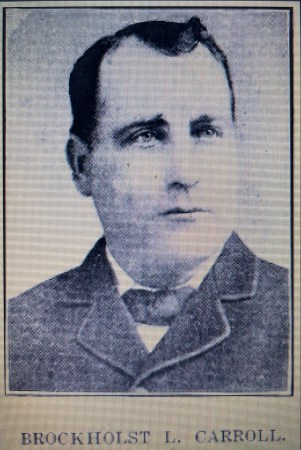
Brock stands for Brockholst Carroll, apparently a prominent Far Rockaway name at the turn of the century. He served as the last Village President of Far Rockaway (before they became part of NYC). His photograph appeared in the “History of the Rockaways from the Year 1685 to 1917,” by Alfred H. Bellot.

His mineral water business existed from at least the mid 1870’s until his death in 1905.

The first listing I can find for Brockholst L. Carroll was in the Rockaway section of the Lain’s Directory of Long Island in 1878 -1879, classified as mineral water. He was also listed as the excise commissioner in the same directory.

The business was listed under Soda and Mineral Water in the Far Rockaway section of the 1890 Lain’s Business Directory of Brooklyn, located at the foot of Broadway. According to “Far Rockaway Reminiscence” a presentation given by Valentine Smith in 1934, the original bottling plant on Grandview Avenue burned to the ground on Columbus Day 1892.

Later, the business continued to be listed as a manufacturer of mineral water. In the 1899 Trow Business Directory of the Borough of Queens two locations were given: Broadway in Far Rockaway and Central Avenue in Lawrence. It was also listed in the 1903 Trow Business Directory of the Borough of Queens with just the Broadway location (foot of Broadway).

Carroll passed away in 1905 after which the April 15, 1905 edition of the American Bottler reported:

Mrs. B. L. Carroll has sold the mineral water business conducted at Far Rockaway, N. Y., for many years by her late husband, to William Geis.

Strangely, I found the story of Carroll’s death in the February 1, 1905 edition of the Scranton (Pa.) Republican.

Brockholst Carroll Passed Away. A Hymn on His Lips.

New York, Jan 31. – Brockholst L. Carroll who was the last president of the village of Far Rockaway, died in his home in Review Avenue, Far Rockaway, Sunday evening.

Mr. Carroll was fifty-eight years old. Calling his wife and five children to his bedside on Sunday afternoon he told them he believed his end was near and began to sing hymns.

At night he grew weaker, and then he started to sing “Think of Me.” After a few words he gasped for breath and passed away.

Grandview Avenue is currently named Beach 17th Street and Broadway is named Beach 19th Street. Based on the address given as the foot of Broadway, I suspect that the business (both original and rebuilt) was located near the ocean beach between what is now Beach 17th and Beach 19th Streets.  The second location in Lawrence may have been needed during the rebuilding process. The area between Beach 17th and 19th Streets now serves as parking for beachfront residential high rises.

His bottles are one of the most plentiful finds on the bay,  probably because they are extremely heavy and durable. I’ve found a total of 18 (16-8oz pony’s and 2-28 oz sizes) and all are tooled blob tops. I’ve never observed a crown top finish or machine made version. This agrees with a 1905 or earlier end date.

The embossing on all of them refers to “Far Rockaway Long Island.” This would indicate they were manufactured in 1898 (the year Far Rockaway became part of NYC) or earlier. I’ve never found one with “Far Rockaway N.Y.”embossing so it’s possible he just never went through the cost of changing his molds. I’ve also never found one embossed with the Lawrence location.

The embossing includes a picture of two gentlemen seated at a table that are being served bottles of presumably Brock Carroll Mineral Water by a waiter with a large mustache.