Mike’s Collection

P. B. Knapp, Druggist, 362 Hudson Street, New York


knapp-1

The P stands for Peter B. Knapp whose business dated back to 1839. Knapp ran a medicine warehouse at 362 Hudson Street where he sold proprietary medicines, both wholesale and retail. The business is listed in the 1847 NYC Directory at that address and remained there through at least 1932. It was listed at (or more probably expanded to include) 373 Hudson Street and later 388 Hudson Street from 1933 to 1949.

Relatively early on in their history, the business manufactured and marketed patent medicines, including Knapp’s Indian Strengthening Plaster and Knapp’s Extract of Roots. An advertisement for Knapp’s Indian Strengthening Plaster found in the April 21, 1845 issue of the Brooklyn Daily Eagle touts:

Knapp’s Celebrated Indian Strengthening Plaster. –  These plasters prepared for pains and weakness in the back, breast, side or limbs, rheumatism, weakness and pain in the chest or loins, across the kidneys, or between the shoulders, liver complaints, diseases of the lungs, lumbago, bruises, sprains and other local injuries of a like nature. Knapp’s Indian Strengthening Plaster will prove, it is confidently believed, the most efficacious outward application that medical science has ever placed within the reach of suffering humanity.

A July 1876 advertisement for Knapp’s Extract of Roots stated:

One of the healthiest and pleasantest beverages known is made from this extract, the reputation of which has been well established for over 30 years…

More on Knapp’s Extract of Roots can be found in another post on this site. Knapp’s Root Beer Extract

In 1877 the business was also listed as a New York agent for Dr Underhill’s Pure Wines.

Peter Knapp was involved in the business through 1893, when as the Senior Partner an issue of Chemist & Druggist mentioned that he was one of the oldest druggists in New York.

Sometime in the late 1890’s, Peter passed away but the business apparently remained in the family. Gilbert Knapp was listed as the firm’s active partner in 1903. Around this time they published a 16-page booklet entitled “A Pig and a Poke and Other Stories”in commemoration of the fact that their prescription series had reached the half million mark. An excerpt follows:

One hundred dollars would not do so much now, but in the year 1839 Peter B Knapp established a drug store with it. He had served a long apprenticeship at Van Kleeck’s on lower Sixth Avenue, and wanted to own a store of his own. He bought his stock and it was delivered to him, all in one load.

People believed in home-brewed herb remedies in those days and knew how to prepare them. The little herbarium thrived. Cherished household recepies were brought there to be compounded. The forefathers of the present generation had there infantile colics soothed with catnip that could nowhere else be found of such full fresh flavor as at Knapp’s. It wasn’t so big a place then as it is now, and it wasn’t on the corner. As the business grew, the store deepened and the corner was finally taken in. The firm of P. B. Knapp & Sons now occupies the greater part of two buildings and an annex besides.

The lines of development of late years in Messrs Knapp & Sons’ business have been in the development of a prescription department which is unique and in some respects unequalled in the City. This department, in which confidence is everything now constitutes the main part of their business.”

In 1920, the Knapp family is apparently no longer involved with the business. The Directory for that year names August Hardinger as the only principal. According to a reader of an earlier version of this post:

I can tell you that August Hardinger, the pharmacist who had purchased the store in 1920, retired and closed up shop in 1949.

Thanks for the update Carol!

The bottle I found is a small square mouth blown pharmacy bottle with a tooled finish. It has the 362 Hudson Street address on it and most likely dates back to their prescription department of the early 1900’s.


Jones Pharmacy, Ninth Avenue, Cor. 53rd St., New York


jones-long

John H. Jones was born in England about 1852. According to 1910 census records he immigrated to the United States in 1876.

John H. Jones, drugs, was first listed in the NYC Directories at 977 Eighth Avenue around 1876/1877.  Sometime around 1888 he moved to 798 Ninth Avenue (at 53rd Street) where he conducted a drug store up through at least 1925. The 1905 ERA Directory indicated that his store provided services in the following categories: drugs and medicine, drug sundries, tobacco or cigars and books or stationary.

The IRT Ninth Avenue Line, the first elevated line in the City, ran right by the Jones Pharmacy. It was called “the cable” because originally the cars were propelled by a series of one-mile long cable loops that ran between the rails that were driven by stationary engines placed in buildings adjacent to the line. “The Cable” made a sharp turn at 53rd Street, directly adjacent to the Jones Pharmacy, which led to this item found in an 1895 issue of the American Druggist and Pharmaceutical Record.

A number of accidents take place there and, as might be expected, the injured persons are at once carried into the drug store while an ambulance is being summoned or the exact state of the injured man’s condition is ascertained. During June (1895) there have been perhaps a half a dozen people carried into the store and temporarily treated. On each occasion, Mr. Jones suffered loss of goods from contemptible pilferers who must have gathered in the crowd and followed in, simply to steal whatever they could get their hands on.

Jones was still listed as a druggist at the 798 address as late as 1925. By 1930, now 78 years old, census records list his occupation as “clerk” in a “drug store,” so he had apparently sold out by then. His wife Emily was living alone and working as a “cook” in 1940, suggesting that John passed away sometime in the 1930’s

Today 798 Ninth Avenue is a five-story walk-up with a commercial store at street level. It almost certainly dates back to the time of the business. Today it houses a business called “The Meatball Shop.”

Screenshot

The bottle I found is a small (approximately 4 oz) mouth blown medicine bottle with a tooled finish. Embossing on the base indicates it was made by Whitehall Tatum Company (W.T. Co). The fact that there’s no ampersand (between the T and Co) indicates it was made after that business incorporated in 1901.

On a final note:

As early as 1906, a company named J. F. Abbott Co. also listed 798 Ninth Avenue as their address. The company advertised  a patent medicine called “Judd’s Antiseptic Foot Powder” in several 1906 editions of a newspaper called “New York Age.”

1912 and 1919 NYC Copartnership and Corporation Directories and the 1922 Directory of Drug Manufacturers and Proprietors listed the proprietors of JF Abbott Company as Judson F and James L Abbott, so Judson Abbott was apparently the product’s namesake. Whether the Abbott’s and Jones were associated or simply occupied individual stores  in the same building is not clear.


Hegeman & Co., New York


The namesake of the business, William Hegeman, was a native of New York City, born in 1816. His career story, as told in court records of “Hegeman & Co. against Johnston N. Hegeman,” begins with the drug business of Rushton & Aspinwall.

In 1827, one William L. Rushton established, in the city of New York, a business in the sale, by wholesale and retail, of drugs and medicines, with which was put up of medical prescriptions, and of special preparations known by names of his own creation or adoption. In 1832 he associated with him one Aspinwall, and in 1843 William Hegeman, who had originally been in Rushton’s employment, became a partner in the place of Aspinwall.

A publication called “The Old Merchants of New York” by Walter Barrett, published in 1863 picks up the story from there.

 After Rushton & Aspinwall dissolved, I think Mr. Aspinwall kept on the wholesale store in William Street, and Rushton the retail store on Broadway, under the firm of Rushton & Co. Mr Rushton took in a Mr. Clark who had formerly been a partner in the firm of Clark & Saxton, in Broadway. Shortly after, Rushton died.

In 1855, as a result of Rushton’s death the name of the business was changed to Hegeman, Clark & Co. The notice announcing the name change appeared in the January 25, 1855 edition of the Brooklyn Daily Eagle.

The notice mentioned three Broadway locations; 165, 273 and 511 Broadway.

Later, advertisements published in the fall of that year indicated a fourth location at 756 Broadway. Their wholesale depot was located at 165 Broadway while the other three were retail outlets.

Apparently manufacturing chemists as well, the most heavily advertised product under the Hegeman name was their “Celebrated Genuine Cod Liver Oil.” This advertisement that appeared in the December 3, 1856 edition of the Brooklyn Times Union mentioned nine years experience which would date the product back to the Rushton & Aspinwall days.

Beginning in 1859 Clark was dropped from the company name, now referring to it as Hegeman & Co. in both the directory listings and advertisements.

Around this time the company advertised a number of proprietary products under the Hegeman name. In addition to their cod liver oil, 1859  advertisements mentioned Hegeman & Co.’s Camphor Ice With Glycerine and Concentrated Benzine.

Sometime in the early 1860’s it appears that the company moved their main depot to 203 Broadway and would continue to list it along with three retail locations, also on Broadway, up through the mid-1870’s. Between 1861 and the early 1870’s they also listed a fifth location at the corner of 4th Avenue and 17th Street.

In 1867 William’s son, Johnston N Hegeman, joined the business in partnership with him and both were listed with the company up until William’s death in October, 1875. At that point, according to a January 12, 1878 story in the New York Times:

Mr. J. N. Hegeman, his son and only partner, continued the business, but, since his father’s death, has gradually disposed of the numerous branch stores once owned by the firm. The last one, at No. 603 Broadway was sold for $10,000 in November 1876.

The story went on to say that with Johnston, confined to his house in Orange New Jersey suffering with inflammatory rheumatism and under the influence of morphine treatments, the company went into receivership in January, 1878.

Subsequently court records indicated that some of the company’s stock along with it’s trademark, goodwill and as connected with it the business name, all preparations, recipes, formulas, prescriptions and recipe books, labels, plates, proprietary rights, and proprietary articles were sold and ultimately transferred to a newly formed corporation, also called Hegeman & Co., whose certificate of incorporation was filed on March 14, 1878. Associated with the new corporation was George B. Marcher who had been previously employed by William Hegeman, much of it supervising the compounding the Hegeman preparations.

At around the same time J. N. Hegeman, now apparently fully recovered, associated with J. W. Ferrier, another employee of the old firm and began business in a store a 756 Broadway, which had formerly been one of the branch stores of the old firm that had been sold previously and now reacquired.

In 1880 Hegeman & Co  was listed at the old firm’s 203 Broadway location and J. N. Hegeman & Co, Wholesale and Retail Druggists was listed at 756 Broadway. Both claimed to be successors to the original Hegeman Company which resulted in this note that accompanied J. N. Hegeman’s listing in the 1880 NYC Directory:

Mr. Hegeman has no connection with any other drug house in the City.

Both firms continued to operate independently up through the early 1900’s.

J. N. Hegeman & Co. incorporated in February, 1894. The notice of incorporation was published in the February 14, 1894 edition of the New York Tribune.

J. N. Hegeman & Co. filed a certificate of incorporation yesterday. The concern will do a general drug business with a capital of $50,000. Its directors are J. Niven Hegeman, Joseph Glenny, John W. ferrier, Lucius A. Wilson, Herbert S. Barnes and Acton C. Bassett.

Later that year, in October 1894, J. N. Hegeman passed away. However, the J. N. Hegeman business remained listed in the NYC Directories up through through 1906. At that point, the 1907 NYC Copartnership and Corporation Directory indicated that the J. N. Hegeman Co. had been absorbed by Hegeman & Co., Inc.

The corporation of Hegeman & Co. was listed through 1909 and in 1910 was merged with the William B Riker & Son Co. A 1910 issue of American Druggist summarized the merger:

At a meeting of the officials of the William B Riker & Son Company and Hegeman & Co on August 4, negotiations were completed merging the two concerns into a new company. The corporation is to be known as the Riker & Hegeman Company. No details as to when the combination is to become effective have been given out but October 1 is said to have been decided on… At the time Hegeman & Co was capitalized at $6 million and Riker & Son at $2.5 million. John H Flager, president of Hegeman will be president of the new organization… The result of the combination and probably what brought it about is the desire to abolish competition between stores in both chains. In several spots of the City, Riker and Hegeman have stores on opposite sides of the street. Establishments in such close proximity will be given immediate attention, according to plans, and expenses reduced by closing down one or more in a neighborhood… It’s quite likely the new corporation will expand it’s retail business to other cities with a view of ultimately opening a chain of sores across the country.

Just before the merger, Hegeman & Co. still had their main store at 203 Broadway, 19 branch stores (17 in NYC, 1 in Jersey City and 1 in Yonkers) and a warehouse at 66 W 132nd Street. Riker had 25 stores in the NYC vicinity and several in Boston.

In 1916, Riker-Hegeman merged with the United Drug Company resulting in a company with 152 retail drug stores.

Over the years I’ve found two Hegeman bottles. One is mouth blown with an applied finish and approximately 4-5 oz. in size. Embossed in small letters under Hegeman & Co are the words “a corporation.”

The other is a small 1 ounce brown bottle embossed “The Corporation of Hegeman & Co.” It’s also mouth blown.

This “corporation” reference embossed on both indicates they were manufactured between 1878 when the company incorporated and 1910 when it merged with Riker & Son. The larger one with the applied lip likely dates slightly earlier than the brown one.

Haas Pharmacy


haas-long

The business started around the mid-1870’s and was still active well into the 1950’s.

Between 1876 and 1894 Frederick Haas appeared in the NYC Directories listed as drugs at 266 Fourth Avenue (at 21st Street).  In 1896 the Haas Pharmacy name was included in the directories for the first time and two locations were given, 266 Fourth Avenue and 439 Fifth Avenue (at 39th Street).

According to the January 13, 1905 edition of the New York Times, the Haas Pharmacy of New York incorporated at that time. The directors were Frank Rudd, J.N. Blair and L.F. Staar of New York. Frederick Haas was not mentioned so apparently he had left the business by this time.

Around the same time, the 1905 ERA Directory indicated that the Fifth Avenue store provided services in the following categories: drugs and medicine, drug sundries, books or stationary and that the store had a soda fountain. The Fourth Avenue store provided drugs and medicine, drug sundries, tobacco or cigars and books or stationary.

According to several annual issues (between 1905 and 1922) of the ERA Druggist Directory of the US, Canada, Cuba, Puerto Rico, Manila and the Hawaiian Islands:

  • The 439 5th Avenue location moved to 7 W 38th Street around 1907.
  • The 266 Fourth Avenue location moved to 38 E 22nd Street around 1913. Both the Fourth Avenue and E 22nd Street addresses were listed in 1913.
  • The 7 W 38th Street location moved to 28 W 38th Street around 1913.

Haas Pharmacy continued to be listed at various locations well into the 1950’s. The 38 E 22nd Street location was still listed in the 1933 Manhattan Telephone Book along with 35 E 49th Street. Between 1940 and 1945 I found them at 376 Park Avenue and in 1957 they’re located at 812 Madison Avenue.

There’s actually a Haas & Thomas Pharmacy today on E 65th Street in Manhattan but I’m not sure if there’s a connection.

In addition to being a retail druggist Haas apparently manufactured drugs for distribution as well. Advertisements for “Neurotone-Haas, a glycerophosphate of lime and soda, appeared in several of the drug trade journals between 1904 and 1907.

haas-ad

In and around 1914, the Court of Special Sessions dismissed a case against Frederick Haas, who was charged with violation of the NYS labor law for failure to file a certificate of the working hours of his clerks with the Commission of Labor. This decision resulted in the Water Bill, which provided the state pharmacy law and not the NYS Labor Law, has jurisdiction over the practice of pharmacy in NYS and can therefore prescribe the hours of employment for drug clerks. The state pharmacy law at the time limited the hours of employment by drug clerks to not more than seventy hours in a week or 132 hours in any two weeks. (Yikes!) The labor law at the time required one day of rest in every seven for all employees of mercantile establishments and factories.

The only building that appears to date back to the business is located at the 28 W 38th Street address. It’s a turn of the century building with a commercial store at street level. The former 7 W 38th Street location is now within the footprint of Lord and Taylor’s flagship store on Fifth Avenue that opened in 1914. Fourth Avenue is now Park Avenue South.

I’ve found two mouth blown Haas Pharmacy medicine bottles, both with rectangular cross sections.  One holds approximately 4 oz. and the other is smaller, holding no more than an ounce. Both have a tooled finish and were probably made in the late 1800′ s or early 1900’s and associated with one of their early locations, either Fourth Avenue or Fifth Avenue ( filled and sold by a guy working 70 hours a week!).

W. H. Gardner, 176 State Street, Bridgeport, Conn.


gardner-long

W H Gardner is profiled in “Connecticut of Today: It’s Chief Business Centers” published in 1890. He’s included as a businessman in the Bridgeport section:

W H Gardner, Druggist No 176 State Street – One of the most successful and flourishing pharmacies in the City of Bridgeport is that of Mr. W H Gardner at 176 State Street. This gentleman is a native of this state and for many years was the occupant of a responsible position in the wholesale drug house of Hazard, Hazard & Co of New York. Having by a long course of arduous study and a practical training in the laboratory, fitted himself for the responsible profession in which he is engaged. In 1886 he established his present business and from the start secured a large and first class patronage. The store he occupies is centrally located, elegantly arranged and handsomely fitted up with artistic counters, shelving, plate glass, show windows and cases, marble soda fountain and is provided with all that can promote the comfort and convenience of his customers. The stock embraces a large and carefully selected assortment of pure fresh drugs and chemicals; proprietary remedies of well known and established reputation; toilet and fancy articles, perfumery and druggists’ sundries, physicians and surgeons’ supplies; extracts, acids and essences; roots, herbs and barks; tinctures, etc. Mr. Gardner makes a specialty of toilet and fancy articles, and French, English and American perfumes and powders and in these lines his assortment is unrivaled in Bridgeport for variety, quality and quantity. Particular attention is given to the compounding of physicians’ prescriptions and family recipes, and every care is taken to secure accuracy while the prices charged are invariably moderate. Skilled and experienced assistants are employed and prescriptions are filled at all hours of the day or night. Mr. Gardner possesses fine business ability and is popular with all classes of the community.

According to the Bridgeport directories, Gardner was in business from 1886 until 1912. He remained at 176 State Street until 1898 at which time he moved to 119 State Street. In 1900 he moved again, this time to 215 State Street, where was listed through 1912. Gardner’s wife Katherine was described as a widow in a 1918 newspaper story, so I assume he passed away sometime between 1912 and 1918.

I didn’t find any advertisements for the business, but Gardner was quoted in a series of 1892 -93 newspaper advertisements for a proprietary medicine called “Comfort Powder”

The building Gardner occupied at 176 State Street no longer exists. Today its former footprint is within a park called McLevy Green. His building at 215 State Street remains to this day. The year 1896 appears on a large stone above the entrance to the building, so it looks like Gardner moved there within a few years of the building opening.

The buildings main address is 211 State Street, so its almost certain that Gardner occupied one of the street level spaces using the 215 State Street address.

The bottle I found is small (maybe 3 oz) with a tooled finish. It has the 176 State Street address embossed on it. Embossing on the base indicates it was made by the Whitehall Tatum Company (W.T. Co). The fact that there’s an ampersand (between the T and Co) indicates it was made before that business incorporated in 1901. A web site article on Whitehall Tatum puts the specific embossing in the 1880 to 1895 time frame. Recognizing that the business started in 1886, the bottle probably dates between 1886 and 1895, but absolutely no later than 1898, when they moved to 119 State Street.

Charles S. Erb, Pharmacist, 121 Amsterdam Avenue, Cor 65th St., N.Y.


erb-long

The November 15, 1897 Issue of Merck’s Report featured Erb as a “Leader in the Drug Trade” It states:

While working as a clerk in the drug store of G F Werner Mr. Erb took a full course at the College of Pharmacy, graduating from that institution in 1886. He speedily worked his way up to trusted manager of a pharmacy, and around 1890 concluded to embark in business for himself. In 1891 he opened the store at 121 Amsterdam Avenue, and by his originality and push he has succeeded in making his establishment one of the features of his neighborhood. He has already attained considerable local celebrity as a manufacturing pharmacist.

Erb was listed in the NYC directories as a druggist at 121 Amsterdam Avenue up through 1905. The 1905 ERA Druggist Directory listed the services he provided under the following headings: Drugs and Medicines, Drug Sundries, Tobacco or Cigars and Books or Stationery. He was also listed in that directory as a manufacturer of proprietary medicines.

In 1906 he moved the business to 108 Amsterdam Avenue. His move was documented in a 1906 Issue of “American Druggist and Pharmaceutical Record”

On July 1, 1906 Charles S Erb will move from his present location at Amsterdam Avenue and 65th Street to a new store at 108 Amsterdam Avenue between 64th and 65th Streets. The building now occupied by Mr. Erb is being torn down to make room for a public school.

The business remained listed in the ERA Druggist Directories at 108 Amsterdam Avenue up through 1913-14.

Erb passed away in February 1914. His obituary, in the March 1914 Issue of the “Pharmceutical Era,” stated in part that he was ex-president of the New York College of Pharmacy Alumni Association, a trustee of the College of Pharmacy, and at one time secretary of the New York State Board of Pharmacy.

Today, the Fiorello LaGuardia High School of Music occupies the west side of Amsterdam Avenue between 64th and 65th Streets. It’s located in a modern high-rise building that takes up the whole block. There’s no sign of the building that housed the Erb business.

The bottle I found is a small (approximately 3 oz) mouth blown medicine with a tooled finish. It has the 121 Amsterdam Avenue address so it’s manufacture date ranges between 1891 and 1906.

Cosmopolitan Pharmacy, Corner Rivington & Willett Streets, New York


cosmo-long

The proprietor of the Cosmopolitan Pharmacy was Sigmund Muldberg. A physician who graduated from Belgium’s University of Ghent in 1889, he immigrated to the United States shortly thereafter.

The ERA Druggist Directory in 1905 and 1906 included the following listing under “Retail Druggists”

Sigmund Muldberg (Cosmopolitan Pharmacy), 79 Willett Street.

These are the only two listings I can find that provide a direct connection between Muldberg and the Cosmopolitan Pharmacy. However between 1896 and approximately 1908 Sigmund Muldberg was listed individually in the NYC general directories as a druggist and physician. Generally (but not always) the physician listings included an address of 234 Rivington Street and the druggist address was 79 Willett Street.

According to the 1905 ERA Directory the pharmacy provided services in “drugs and medicines” and “drug sundries.” It did not include other services typical of pharmacies of the time including tobacco products, liquor products or a soda fountain.

This all leads me to conclude that Muldberg probably ran both a doctor’s office and associated pharmacy/drug store out of the same building on the corner of Willett Street and Rivington Street (the location embossed on the bottle). If I’m right, the “Cosmopolitan Pharmacy” name may date back as early as 1896.

Around 1909 Muldberg relocated to 323-325 Second Avenue where he remained listed until at least 1922. In 1925 he was listed at 411 West End Avenue. After 1911 he singularly listed his occupation as “physician”, and no longer included “druggist.” in any listing that I could find.

Muldberg was not listed in the 1933 NYC directory and 1940 census records listed his wife, Annie, as a widow. This indicates that he passed away sometime between 1930 and 1940, probably prior to 1933.

There was a Cosmopolitan Pharmacy listed in the NYC directories between 1909 and 1915 with an address of 612 Tenth Avenue . The name of the proprietor was Reuben Hird. It’s possible that Muldberg sold his pharmacy business to Hird in 1909 but I can’t make a definite connection.

Rivington Street and Willett Street both no longer exist at this intersection. They area is now part of the Samuel Gompers apartment building complex.

The bottle I found is a small (approx. 4 ounce) mouth blown medicine with a tooled finish. It  was made by the Whitehall Tatum Company and that company’s name is embossed on the base. The embossing includes an ampersand (between Tatum and Co) indicating it was made prior to 1901 when Whitehall Tatum incorporated. This is further evidence that the “Cosmopolitan Pharmacy” name may date back to 1896 and dates the bottle to the period between 1896 and 1901.


Brock L Carroll, Far Rockaway L.I.

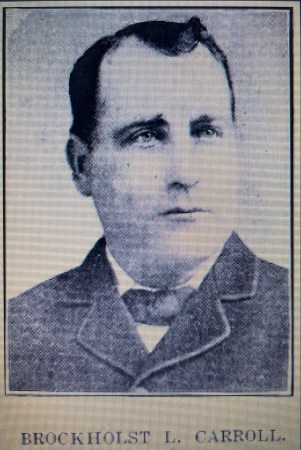
Brock stands for Brockholst Carroll, apparently a prominent Far Rockaway name at the turn of the century. He served as the last Village President of Far Rockaway (before they became part of NYC). His photograph appeared in the “History of the Rockaways from the Year 1685 to 1917,” by Alfred H. Bellot.

His mineral water business existed from at least the mid 1870’s until his death in 1905.

The first listing I can find for Brockholst L. Carroll was in the Rockaway section of the Lain’s Directory of Long Island in 1878 -1879, classified as mineral water. He was also listed as the excise commissioner in the same directory.

The business was listed under Soda and Mineral Water in the Far Rockaway section of the 1890 Lain’s Business Directory of Brooklyn, located at the foot of Broadway. According to “Far Rockaway Reminiscence” a presentation given by Valentine Smith in 1934, the original bottling plant on Grandview Avenue burned to the ground on Columbus Day 1892.

Later, the business continued to be listed as a manufacturer of mineral water. In the 1899 Trow Business Directory of the Borough of Queens two locations were given: Broadway in Far Rockaway and Central Avenue in Lawrence. It was also listed in the 1903 Trow Business Directory of the Borough of Queens with just the Broadway location (foot of Broadway).

Carroll passed away in 1905 after which the April 15, 1905 edition of the American Bottler reported:

Mrs. B. L. Carroll has sold the mineral water business conducted at Far Rockaway, N. Y., for many years by her late husband, to William Geis.

Strangely, I found the story of Carroll’s death in the February 1, 1905 edition of the Scranton (Pa.) Republican.

Brockholst Carroll Passed Away. A Hymn on His Lips.

New York, Jan 31. – Brockholst L. Carroll who was the last president of the village of Far Rockaway, died in his home in Review Avenue, Far Rockaway, Sunday evening.

Mr. Carroll was fifty-eight years old. Calling his wife and five children to his bedside on Sunday afternoon he told them he believed his end was near and began to sing hymns.

At night he grew weaker, and then he started to sing “Think of Me.” After a few words he gasped for breath and passed away.

Grandview Avenue is currently named Beach 17th Street and Broadway is named Beach 19th Street. Based on the address given as the foot of Broadway, I suspect that the business (both original and rebuilt) was located near the ocean beach between what is now Beach 17th and Beach 19th Streets.  The second location in Lawrence may have been needed during the rebuilding process. The area between Beach 17th and 19th Streets now serves as parking for beachfront residential high rises.

His bottles are one of the most plentiful finds on the bay,  probably because they are extremely heavy and durable. I’ve found a total of 18 (16-8oz pony’s and 2-28 oz sizes) and all are tooled blob tops. I’ve never observed a crown top finish or machine made version. This agrees with a 1905 or earlier end date.

The embossing on all of them refers to “Far Rockaway Long Island.” This would indicate they were manufactured in 1898 (the year Far Rockaway became part of NYC) or earlier. I’ve never found one with “Far Rockaway N.Y.”embossing so it’s possible he just never went through the cost of changing his molds. I’ve also never found one embossed with the Lawrence location.

The embossing includes a picture of two gentlemen seated at a table that are being served bottles of presumably Brock Carroll Mineral Water by a waiter with a large mustache.

Henry Brenwasser, Pharmacist, 226 Ninth Avenue, Cor. 24th St.


brenwasser-long

Henry Brenwasser, according to 1920 census records, was born in Hungary circa 1884 and arrived in the United States in 1895. In December, 1904 the “Pharmaceutical Record’ announced that he was one of 81 applicants who “passed the recent Board examination held in the Brooklyn College of Pharmacy.”

The first mention of Henry Brenwasser in the NYC Directories that I can find is 1908/1909, when he’s listed as a druggist with the 226 Ninth Avenue address embossed on the subject bottle.  Around this time he apparently went into business with Frank N Pond.

The business of Pond & Brenwasser (Frank N Pond & Henry Brenwasser) was listed in the Trow NYC Copartnership and Corporation Directories from 1908 to 1914 at the 226 Ninth Avenue address. The business was not listed in the 1906 Copartnership and Corporation Directory. By 1914 Pond and Brenwasser was listed as dissolved.

According to the February 3, 1913 issue of “Industrial World” and an issue of the “Paint, Oil and Drug Review” around the same time, Brenwasser was an incorporator in a new business called Glycola Co, Inc. The company was listed as “chemists, dry salters, oil and color men. Capital $75,000. Incorporators: Jeheil H Patrick, 333 Ninth Avenue, Furman K Ruff MD, 343 W 23rd St and Henry Brenwasser, 226 Ninth Avenue. The 1915 – 1916 Directory of Directors in the City of New York list Brenwasser as the Secretary and Director of the Company, still located at 226 Ninth Avenue. The company is not listed in the 1918-1919 Copartnership and Corporation Directory.

In the 1921 and 1922 editions of the ERA Druggist Directory of the US, Canada, Cuba, Puerto Rico, Manila and the Hawaiian Islands, Henry Brenwasser (No Pond) was listed as a retail druggist at the Ninth Avenue address. This suggests that he likely remained in the retail drug business while also participating in Glycola, or they were in essence, one and the same. Brenwasser was still listed in the Manhattan telephone book with the occupation “pharmacy” as late as 1949.

The Brenwasser pharmacy was still located at the Ninth Avenue location for much, if not all of the 1960’s. Now appearing as H. Brenwasser, Inc., the pharmacy was included in an advertisement for Squibb’s Vigran Vitamins in the January 3, 1964 edition of New York’s “Daily News.”

Later, as late as  July 11,  1968, the “Daily News” included the pharmacy on a list of New York State Lottery outlets.

Frank N Pond also maintained other businesses associated with the 226 Ninth Avenue address before (Pond & Bowes), during (Pond Pharmacal Co.) and after (Pond Prescription Pharmacy) the Pond & Brenwasser era of 1908 to 1912. It’s not clear whether Pond and Brenwasser remained associates or not but it appears they shared the building or at least the address until at least 1916. There appears to be no connection with the more famous Pond’s Extract Co.

Today 226 Ninth Avenue no longer exists. The location is now part of a large apartment complex.

The bottle I found is a small (3 oz) mouth blown medicine bottle with a tooled finish. Embossing on the base indicates it was made by Whitehall Tatum Company (W.T. Co). The fact that there’s no ampersand (between the T and Co) indicates it was made after Whitehall & Tatum incorporated in 1901. Coupled with the fact that that Henry Brenwasser’s name is embossed on the bottle, not Pond and Brenwasser, suggests it was likely manufactured after Pond & Brenwasser was dissolved in 1914.