Mike’s Collection

A. G. Groblewski & Co., Plymouth, Pa., U.S.A.


Beginning in the early 1890’s Albert G. Groblewski was a retail druggist and patent medicine manufacturer headquartered in Plymouth, Pennsylvania. Initially a one man operation, by 1930 his company, Albert G. Groblewski & Co., Inc., had grown to the point where it was manufacturing in excess of 60 different patent medicines under the Groblewski name. The company, always headquartered in Plymouth remained operational until the early 1970’s.

Their marquee product, Rattlesnake Liniment (later called simply Groblewski’s Liniment) was on the market for much, if not all of the company’s lifetime. This advertisement for his “Rattlesnake Brand Liniment” along with two others, “Linden Cough Balsam and  “Bear Brand Salve,” appeared in the 1930 “North American Almanac.”

A Polish immigrant, Groblewski was born in April, 1862 (1900 census records) and arrived in the United Sates sometime in the 1870’s (1872 in 1900 census records and 1876 in 1910 census records). This photograph of Groblewski along with his wife Helena, circa 1915, was found in the June 6, 2004 edition of the Wilkes-Barre “Times Leader.”

Groblewski’s early history as a Pennsylvania druggist was summarized in his April 18, 1925 obituary, published in the Wilkes-Barre “Times Herald.”

…At the age of 16, he came to this country with his parents to Nanticoke, where the family resided for 10 years. His early education was received in Poland. After arriving in Nanticoke, Mr. Groblewski secured a position as a clerk in a drug store, conducted by the late Dr. Sutliff…

After serving ten years as a clerk in a drug store at Nanticoke and with his rapid advancement and knowledge he was made manager of a drug store at Glen Lyon, which position he held for three years. Gaining an increasing knowledge in the druggist-business, he sought to own a business of his own, and in 1890 he moved to Plymouth, where he purchased the drug business of Jonathan R. Davis, at 111 East Main Street. Two years later he started the manufacturing of drugs which proved a tremendous success.

Those early years in business were described like this in a feature on Groblewski published years later in the May 12, 1930 edition of the “Times Leader.”

At 111 East Main Street, Plymouth, in a small one room drug store and with an investment of but $500 Groblewski started this business… A yearly sale of products turned out for the most by his own hands was $150 in that early day when the now famous rattlesnake liniment was first presented to the business world.

It wasn’t until later in the decade that advertisements for Rattlesnake Liniment along with another patent medicine called Egiuterro began appearing in the local Pennsylvania newspapers. This early advertisement featuring both appeared in several August, 1898 editions of Wilkes-Barre’s “Sunday News Dealer.”

Also marketed under the Polish name “Zmijecznik ,” this advertisement for Groblewski’s liniment appeared in the June 7, 1900 edition of a Polish language newspaper in Chicago, Illinois called “Zgoda.

Courtesy of “Google Translate” the ad read:

The most effective and best remedy against Rheumatism, Backache, Neuralgia, Catarrh, Headache, Cold, Sore Throat & Cramps

So it’s safe to say around the turn of the century Groblewski was both operating a local retail drug store and manufacturing a line of patent medicines under his name. The drug store was apparently doing quite well as evidenced by this announcement published in the July 18, 1900 edition of the “Times Leader.”

Albert Groblewski has placed a handsome new soda fountain in his drug store.

That being said, it was as a patent medicine manufacturer that Groblewski would ultimately earn both his reputation and fortune and by 1903 that piece of the business had him expanding his 111 Main Street facilities. The announcement appeared in the March 12, 1903 edition of the “Times Leader.”

WILL ENLARGE HIS PLANT

Albert G. Groblewski the manufacturer of Egiuterro and Rattlesnake Liniment, owing to the increased demand for his goods, will shortly build an addition to his present place. Mr. Groblewski now ships 12,000 bottles every month to all parts of the United States, and is so rushed with orders that he cannot supply the demand.

Two years later, according to a December 9, 1905 “Times Leader” story, Groblewski’s manufacturing business continued to grow, both in size and geographical reach.

He manufactures 40 different articles guaranteed to reach the ailing spot and aid in a complete restoration to health and vigor. His offices and laboratories are extensive and well equipped with all the appliances that go to make chemistry a serviceable science… He has about twenty skilled persons employed in laboratory and manufactory and his shipments from Plymouth weekly are very large.

Mr. Groblewski has about 200 agents all over the United States and Canada selling his goods…

Of the 40 articles referenced in the above story, 19 were listed in this advertisement that appeared in the July 8, 1905 edition of the “Wilkes-Barre Times.”

The “Times Leader” story went on to say that by then Groblewski was making shipments overseas as well.

…his fame extends all over the United States and Canada, the British Isles, Germany, France and even to Brazil… He found some difficulty this week in making a large shipment to Brazil. None of the express companies would ship direct owing to lack of facilities in the American merchant marine. He was obliged to ship the goods to Germany and from there have the packages reshipped to Brazil.

All things considered, it comes as no surprise that later in the decade with 111 Main Street apparently maxed out, a March 22, 1907 “Times Leader” story announced that  Groblewski was planning the construction of larger quarters.

MANUFACTURING DRUG PLANT

Albert G. Groblewski, the well known manufacturing druggist, will shortly begin the erection of a building wherein will be manufactured the half hundred different remedies which he has on the market. The building will be at the corner of Main and Elm Streets, the site now occupied by the Well Building, which he purchased some time ago for that purpose. The present building will be moved to the rear and the new one to take its place will be sufficiently large for the employment of a hundred or more hands. It will have all the conveniences known the trade, will be provided with all sanitary improvements, and when completed will be one of the most complete factory buildings in the country. Mr. Groblewski is one of the largest advertisers in the State and notices of his goods are displayed in newspapers published in the various languages.

A year later the company moved into their new facility at 241 East Main Street with the announcement appearing in the March 28, 1908 edition of the “Times Leader.”

This undated photo of their 241 East Main Street facilities appeared in the May 6, 1940 edition of the “Times Leader.”

The photograph certainly suggests that the store front accommodated his drug store while the manufacturing facilities and a printing operation occupied the remainder of the building. The recently added printing operation was described in a March 5, 1908 “Times Leader” story.

New Printing Establishment

Albert G. Groblewski the well known druggist and medicine manufacturer, will establish a printing office in his new building recently erected at the corner of Main and Elm Streets…

Mr, Groblewski has purchased the printing establishment of Alexandre Rynsza, of West Hazleton, and will have the type, presses, etc., removed there and placed in his new building. Some of the presses arrived here today. He intends to establish a general printing office and when all his machinery is placed in position for operation he will then be in a position to do all kinds of printing, both in the English and Polish languages.

He spends several thousand of dollars each year for the printing of advertising matters for the many remedies that he has on the market and which are shipped to all parts of the globe and he contends that it will mean a great saving to him by being able to do his own printing.

Mr. Rynsza, from whom he purchased the printing plant, will have charge of Mr. Groblewski’s printing establishment here and they expect to have it in operation in a few weeks.

Groblewski  remained sole owner of the business until July 12, 1921 when according to a story in the May 13, 1930 edition of the “Times Leader:”

…the corporation of Albert G. Groblewski was formed with a fully paid in capital stock of $150,ooo to take over the entire operations of Albert G Groblewski, Sr., Albert G. Groblewski, Sr. becoming president of the new company and holding office until January 1, 1925, on which date he resigned due to ill health, being succeeded by his son, Bernard Groblewski…

Less than five months after his resignation Albert Groblewski, Sr. passed away  on April 21, 1925

Shortly after taking over the business Bernard gave up the retail drug  business completely. An item announcing the sale of their drug store fixtures found in the October 8, 1925 edition of the “N.A.R.D Journal” suggested the decision was driven by the need for more manufacturing space.

THIS IS A REAL BARGAIN – WE NEED THE ROOM NOT YOUR MONEY

This itemized list of annual sales found in a May 12, 1930 “Times Leader” story justified their need for additional manufacturing space.

The “Times Leader”  story went on to say:

Adding to the above were 500,000 packages of 4 powders each and 60 other articles of importance all of which brought up the total sales during 1929 of Groblewski products to the amount of 854,658 separate ready-for-sale pieces…

…The retail value of the plant’s product today is conservatively placed at $200,000…. Of our annual business 7 percent or about $14,000 worth is done in the Wyoming Valley and 93 percent of our products are sold throughout the rest of the United States and other countries.

The May 12th “Times Leader” story went on to describe the distribution network that was needed to service Groblewski’s over 18,000 retailers, most of whom by 1930, as a result of tariffs, were located in the United States.

At present there are distributing depots for Groblewski & Co. products located at Philadelphia, Pa., Seattle, Wash., Baltimore, Md., New York City, Jersey City, N.J., Brooklyn, N.Y., Chester Pa., Newark, N.J., Passaic, N.J., Buffalo, N.Y., Camden N.J., Cleveland, Ohio, Utica, N.Y., Toledo, Ohio, Detroit Mich., Chicago, Ills., Toronto, Canada and Canton City, China. Besides being sold in these cities products are sold in practically every city and town in the industrial part of the United States. The firm has had inquiries, and receive inquiries very often, from many parts of the world, but due to existing high tariffs and also unfavorable trade regulations it is impossible to sell products in most Foreign countries.

Like many patent medicine manufacturers of the day Groblewski attributed much of his success to advertising, a subject he addressed as early as 1905 in the February 17th edition of the “Times Leader.”

Albert G. Groblewski the well known druggist and patent medicine manufacturer of Plymouth, whose advertisement will be found elsewhere in this paper and whose remedies are well known and highly esteemed all over the country, tells a LEADER representative that he pays between $5,000 and $6,000 for advertising and he expects to keep on increasing the amount year by year because he has learned from experience that advertising is the keystone of success and you cannot do business with profit today without advertising.

By 1930, according to the May 12th “Times Leader” story:

The products of Albert G. Groblewski & Co. Inc. are now advertised in street cars, buses, newspapers, magazines, by novelties, booklets, telephone directories, window displays, show cards, billboards, wall paintings, radio, etc. Albert Groblewski & Co., also advertised by an attractive float, in the Sesqui Centennial parade held July 4th, 1928.

This depiction of their float appeared in the “The Book of the Sesquicentennial Celebration of the Battle of Wyoming, July 1st-4th 1928.”

It’s hard to argue against the success of Groblewski’s advertising but you can certainly take issue with its content. As early as February 20, 1902, this advertisement  in the “Times Leader” claimed:

… any person who uses my Egiuterro No. 1 WILL NOT and CANNOT be afflicted with SMALLPOX.

So, as time went on it’s no surprise that claims like this led to charges of misbranding by the U. S. Department of Agriculture.  In one instance this led to the seizure of a June 3, 1916 shipment that contained ten different Groblewski preparations. Specific to Egiuterro, the January 29, 1918 government report stated:

Analyses of samples of the articles by the Bureau of Chemistry of this Department showed the following results:

Egiuterro: The product consists essentially of aloes, magnesium sulfate, jalap, strychnine, alcohol, and water, flavored with methyl salicylate…

… It was alleged in substance in the laboratory that Egiuterro was misbranded for the reason that certain statements appearing on the label falsely and fraudulently represented it as a preventative for smallpox, and as a remedy for rheumatism, dyspepsia, all kinds of fevers, all stomach disorders, all sores, inflammations, swellings, coughs, headaches, for pimples, blotches, boils, and all kinds of skin eruptions which are due to the impure blood or disarranged condition of the liver and kidneys, when in truth and in fact, it was not. Misbranding of the article was alleged for the further reason that it contained alcohol, and the label on the bottle failed to bear a statement of the quantity or proportion of alcohol contained therein.

Other mis-branded preparations included in the siezure were: “Uicure” touted as a cure for rheumatism, pyemia, sciatica, gout, etc.; “Sweet Rest for Children” as a remedy for three-months colic, fretful, cross and nervous babies; “Beaver Drops Comp.” as a remedy for irregular menses, etc.; “Blood Kleen” as a treatment for syphilis, eczema, anemia, cancer and lockjaw; “Heart and Nerve Regulator” as a heart and nerve regulator, a perfect sedative for delirium tremens, St Vitus dance, sleeplessness and nervous headache; “Kidneyleine” as a remedy for Bright’s disease and dropsy; “Eye Powder” as a remedy for cataract and sore eyes; “Tanrue Herbs and Pills” as a remedy for suppressed, painful and irregular menses and “5 Herbs” as a remedy for epilepsy and “fits.”

Twenty-five years later the government was still taking issue with the advertisements for many of their preparations, including Egiuterro, as evidenced by this July 28, 1943 news item found in Hazlton, Pennsylvania’s “Standard-Speaker.”

The Federal Trade Commission has announced that Albert G. Groblewski & Company of Plymouth, has agreed to cease advertising a number of medical preparations unless revealing the possible ill effects which the commission claims would follow their unrestricted use.

The commission said the preparations are Groblewski’s Headache Powders, Groblewski’s Naval Jelly, Groblewski’s Jadol, Nervoteine, Groblewski’s Preparation C, Groblewski’s Powders for Round Worms, Oohotin, Groblewski’s Revila Powders and Egiuterro.

According to this March 21, 1967  item found in “The Scranton Tribune, the company was still addressing misbranding issues in the mid-1960’s.

Headache Powder Seizure Sought

The federal government took steps in Federal Court here Monday for seizure and condemnation of 571 cartons of “Groblewski’s Headache Powders” in possession of Albert G. Groblewski & Co., 241 E. Main St., Plymouth.

Asst. U.S. Attorney Thomas J. Hanlon, in a petition seeking seizure and condemnation of the drugs, stated the shipment was “adulterated and misbranded…”

In spite of their running issues with the government, Albert G. Groblewski & Co. remained in business until 1974 at which time a notice announcing the dissolution of the company appeared in the April 6th edition of the “Times Leader.”

A “Q & A” newspaper column entitled “The Hot Line” found in the “Greensboro (N.C.) Record” suggests that the company was manufacturing their Rattlesnake Brand Liniment up until the very end, or at least until the early 1970’s. On April 18, 1970 the following question appeared in the column.

Q. I need some snake oil, an old time remedy. Where can I get some? D.K.

The answer came six days later.

Tell D.K. he can still purchase the snake oil from manufacturers: Albert G. Groblewski Co., Plymouth, Pa. It comes by one-half box or six bottles. We bought some last time we were in Pennsylvania and its lasted a long time. And D.K. is right – it does the job.

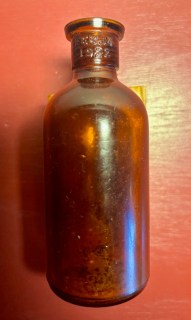
The subject bottle was blown in a mold, contains two ounces and includes the name of “A. Groblewski & Co.” embossed on the face. An unscientific review of the Groblewski directory listings and advertisements suggests that they didn’t begin to use that name until after the business incorporated in 1921.  If that’s the case then the bottle was almost certainly blown at around that time. Anything later and I’d expect a machine made bottle. In fact, by 1921 machine made bottles were quickly becoming the norm.

On a final note: As far as I can tell, the building constructed by Groblewski  at 241 East Main Street in 1907/1908 remains to this day. Sadly, now housing several apartments it barely resembles the original version.


Barry’s Tricopherous For the Skin and Hair, New York

Barry’s Tricopherous was primarily billed as a hair care product that was popular both in the United States and abroad from the mid-nineteenth century up through the early twentieth century. Originally touted as a cure for baldness, by the late 1800’s its suggested uses had expanded to include skin disruptions as well.

An elegant dressing. Prevents baldness, grey hair, and dandruff. Makes the hair grow thick and soft. Cures disruptions of the skin. Heals eruptions and diseases of the skin. Heals cuts, burns, bruises and sprains…

Later, by the 1920’s its claims had been toned down quite a bit with one ad simply saying:

There is no more effective treatment for the scalp and hair than a few drops of Barry’s Tricopherous gently massaged into the scalp two or three times a week… You will feel the healthful effect of Tricopherous. It makes your scalp tingle with health!

A product labeled Barry’s Tricopherous is still made today by the firm of Lanman & Kemp-Barclay.

According to several stories making the rounds on the internet Barry’s Tricoperous was invented in 1801 by the father of a man named Alexander C. Barry. Later advertisements, published in the 1880’s actually state “Established in 1801.”

That being said, New York City directories and early newspaper items paint a different picture, suggesting the product got its start, not in 1801 but in the mid-1830’s, and not with the Barry’s but with a man named  Vair Clirehugh.

In 1835/1836 Clirehugh, a native of Edinburgh, Scotland,  was first listed in the NYC directories at 158 1/2 (later 160) Fulton Street with the occupation “wig maker.” As early as October 27, 1835 this advertisement touting his business appeared in New York’s “Evening Post.”

The advertisement reads:

TO THE LADIES. – CLIREHUGH, Ladies Hair Dresser, from London, respectfully solicits the patronage of the ladies of New York.

The experience of 20 years, and the patronage of the Royal Family and principal Nobility of England, may have some influence in recommending him as an artist whose classic and scientific engagement of the hair will be esteemed by all who study the true graces of the person.

The intended winter fashions have arrived. The costume of the Courts of London and Paris are to be the prevailing mode; and those ladies who will honor his abilities with a trial may at all times depend on his personal attendance.

Ornamental Hair of every description.

158 Fulton street. one door from Broadway, north.

Three years later Clirehugh began advertising what he called “The Tricopherous or Medicated Compound” for the prevention of Badness and Grey Hair, with his earliest ads appearing in October, 1838 editions of New York’s  “Daily Herald.”

Sounding introductory in nature the ad stated, in part:

It is the only effectual remedy ever discovered to prevent baldness and Grey hair – to restore the Hair where it has fallen off – and to eradicate Scruff and dandruff. Prepared by CLIREHIGH, Hair Cutter, 160 Fulton Street, New York.

Although in number and variety there may be no want of specifics for the preservation of the Human Hair, yet the article now presented to the public, though entirely new in its composition, has claims superior to anything of the kind ever offered for the same purpose, its production being the result of extensive medical research and experience.

The proprietor is favorably known in this city, and celebrated as a Hair Cutter and Wig Maker; and for some years prior to his arrival in this country, attended the Lectures of the most distinguished Physiologists in London and Edinburgh, for the purpose of attaining a correct knowledge of the Anatomy of the Skin, the Organization and Structure of the Human Hair, and to trace the causes which produce baldness and grey hair.

The opportunities afforded by his professional duties have assisted his studies, and he has become skilled in the various Diseases of the Skin, as connected with the growth of the hair; and after a series of experiments, this Compound has been produced, with a confidence that it will restore the hair wherever it has fallen out or got thin, as well as preserve it from ever changing color.

By the early 1840’s, advertisements for Clirehugh’s  “Tricopherous or Medicated Compound” were appearing in U.S. newspapers up and down the east coast from Massachusetts  to Washington D.C. This May 19, 1840 “Baltimore Sun” advertisement naming a wig maker named August Croyeau as his local Baltimore agent was typical. 

Sometime, likely in 1841 , three years after Clirehugh began advertising Tricopherous, Alexander C. Barry apparently came on the scene working in Clirehugh’s salon on Fulton Street (he’s not listed in the NYC directories until 1842). At some point, there was some sort of disagreement and Barry was either fired or resigned depending on who you believe, after which Barry, now listed two blocks away at 160 Fulton Street, began selling Clirehugh’s Tricopherous at the discounted price of fifty cents a bottle. The drama that followed played out in the local newspapers beginning with this October 20, 1841 “New York Tribune” item run by Clirehugh.

DARING ATTEMPT AT IMPOSITION. –  A person lately discharged from my employ has had the bare-faced audacity to possess himself of numerous show bills and fancy labels connected with the sale of my Tricopherous. He has likewise issued a handbill headed “Clirehugh’s Tricopherous,” into which he has had the impudence to copy verbatim the principal advertisements of my wrapper, and has put a label and printed “directions for use” on each bottle, similar in every respect to the original, and adds “that it is the same article which he manufactured while in my establishment.” The circumstance of such a gratuitous, unmitigated, and unlashing falsehood only requires to be denied by me, and the person making such assertion held up to public scorn.

I scarce deem it necessary to say that no one at any time, in or out of my employ was ever entrusted with the secret, and could not by any means arrive at it, and that none but myself and son ever knew any thing of its composition or manufacture. His attempt to impose a spurious imitation of the genuine Tricopherous, where he, in his ignorance and cupidity thinks the public will be entrapped to purchase because charged only 50 cents, will be duly appreciated.

The individual who could be guilty of such conduct will not hesitate as to any means he may adopt to deceive and impose on the public…

VAIR CLIREHUGH

Barry’s response appeared the next day in the  October 21, 1841 edition of the “New York Tribune”

TO THE PUBLIC. – The despicable fellow who keeps the Hair Cutting Rooms at the corner of Fulton and Broadway, is openly, but fruitlessly endeavoring to lessen me in the estimation of the Public regarding the sale of “The Tricopherous” elicits this response. So far from being discharged from his employ, as he asserts, I beg to say, that I voluntarily resigned my situation, for the sole reason that he in his usual and degrading system of swindling refused to pay me my just demand, a fact which can be proved in the Third Ward Court. It is likewise false to assert that I did not manufacture the article called “The Tricopherous,” in his establishment; in proof of which I hereby offer the sum of $500 to any chemist in this or any other city, to analyze its ingredients and say that it is not the identical compound sold at the above place for One Dollar, that I sell at Fifty Cents. If this does not satisfy the Public, I will publish the constituent parts of the compound.

A. C. BARRY, 146 Broadway.

Making matters worse, by 1843 both were located on Broadway within two blocks of each other; Clirehugh at the corner of Fulton Street and Barry at the corner of Liberty Street. By then, each was advertising what was almost certainly the same exact product under their respective names, “Clirehugh’s Tricopherous” and ‘Barry’s Tricopherous,” while at the same time accusing the other’s as being an imitation. In a series of September 1843 “New York Tribune” items they went so far as to even accuse each other of copying the wording in their newspaper items.

In his September 1, 1843 item Clirehugh wrote in part:

…To assist the deception, C.’s advertisements have been copied verbatim – the fellow being to ignorant to write one…

And here’s Barry’s September 23, 1843 response, copied verbatim:

To assist the deception Barry’s advertisements have been copied verbatim, the fellow being to ignorant to write one.

The battle in the newspapers simmered down shortly afterward but the two remained competitors for the next decade and a half with each of them marketing what was almost certainly the same, or nearly the same product under their respective names.

During this time Clirehugh  listed various addresses on lower Broadway, with the New York City directories associating him with various occupations that included “tricopherous”as well as “wig maker” and “perfumer.”  An October 24, 1851 advertisement in the “Brooklyn Evening Star” that led with the following headline…

…went on to locate Clirehugh’s ‘principal depot” at 179 Broadway.

At the same time Barry, who had recently anointed himself with the title of “professor…”

…listed his business in the directories at 137-139 Broadway with occupations that included both “wig maker and “tricopherous.”

Clirehugh died suddenly on May 27, 1860. His obituary, published in the June 11, 1860  edition of Toronto’s “Globe and Mail,” told the story.

Our obituary of today contains the announcement of the death of Mr. Vair Clirehugh, a native of Edinburgh, and long a resident of New York, which melancholy event took place on board the steamship “Glasgow” on her voyage to New York. His death was wholly unexpected. He embarked on board the “Glasgow” in apparently robust health, with the view of returning to New York, after a lengthy visit to his native land with the view of spending the remainder of his days in the United States.

Clirehugh’s son who the New York City directories suggest joined him in business sometime in the 1840’s remained in the hairdressing business but apparently did not continue to manufacture or market Clirehugh’s Tricopherous, at least to any great extent. The last mention of Clirehugh’s Tricoperous that I can find was in the September 20, 1862 edition of a Norwich, Connecticut newspaper called “The Bulletin.” Ironically it appeared in an advertisement run by a local retailer that listed both Barry’s and Clirehugh’s Tricopherous  under the single heading of “Hair Preparations.”.

Barry pressed on and sometime in the late 1850’s he moved his operation to 374 Pearl Street where it was first listed in New York City’s 1859 directory. Over the next ten years his operation continued to gain notoriety so much so that advertisements for Barry’s Tricopherous began appearing in such far away places as Australia. One such ad appeared in the August 13, 1862 edition of Austrailia’s “Newcastle Chronicle.”

In 1868, Barry also passed away unexpectedly when according to a story written years later in the September 8, 1912 edition of the “New York Times:”

…Barry fell down three flights of stairs in his residence, 471 Clinton Avenue, Brooklyn, and died of a fractured skull.

Subsequently, according to another story found in the November 17, 1907 edition of Buffalo, New York’s “Illustrated Times,”

Not long after her husband’s death Mrs. Barry sold the business for $10,000. to a nephew.

Not long after, Barry’s nephew, also named Alexander Barry, turned the rights to Barry’s Tricopherous over to a merchant and exporter named  George C. Barclay. In a notice dated  July 15, 1870 Barclay announced that he had acquired the rights to  the generic  name “Tricopherous,” having  not only acquired the rights to “Barry’s Tricopherous,”  but “Clirehugh’s Tricopherous” as well. The announcement appeared as a “Special Notice” in the July 27, 1870 edition of the “New York Daily Herald.” The notice read in part:

AN IMPORTANT NOTICE TO DRUGGISTS AND dealers in proprietary articles. Office of Barry’s Tricopherous for the Hair, 374 Pearl Street, July 15, 1870.- The undersigned begs to notify the trade that he has, by purchase, become sole owner of the good will, trademarks and business of and in “Barry’s Tricopherous,” and of and in “Clirehugh’s Tricopherous;” and he thus becomes the sole possessor of the right to the word “Tricopherous,” and also of the names “Barry” and “Clirehugh” in connection with the word “Tricopherous”…

He then went on to sign the notice

GEORGE C. BARCLAY, Sole Proprietor of “Barry’s Tricopherous” and of “Clirehugh’s Tricopherous.”

The notice in full is shown below.

Initially it appears that the younger Barry and Barclay continued to work together at Barry’s Pearl Street depot where both were listed in early 1870’s editions of Goulding’s Business Directory. As early as 1871 they had even added a hair dye to their menu as evidenced by this July 30, 1871 advertisement that reads:

Barry’s Tricopherous

Does not color hair. It is the best of all dressings and preservers, but BARRY’S SAFE HAIR DYE is expressly for coloring any shade, from a light auburn brown to a beautiful black…

Court records, “Clara S. Barclay v. Reginald G. Barclay,” summarized in the 1915 edition of the “Trade Mark Reporter,” pick up the story from there.

A co-partnership known as Barclay & Co., was formed in 1873 between Alexander Barry and Thomas Barclay. George C. Barclay was not a member of the firm of Barclay & Co., but he controlled and owned the firm name, good will, and the various trade-marks used in the business, which the co-partnership used under a rental agreement with George C. Barclay.

Now located at 26 Liberty Street, the company continued to expand their product line under the “Barry” name, as evidenced by this September 6, 1873 advertisement for Barry’s Pearl Cream.

As early as 1877  they were also selling products under the name “Dr. Reuter” as well. This 1879 “Reuter’s Life Syrup” advertisement  found in a Hartford, Wisconsin newspaper called the “Times Press,” also included a pitch for Barry’s Tricopherous

The partnership between Thomas Barclay and Barry was apparently time limited and “expired by its own limitation” on December 31, 1877. A notice to that effect appeared in the January 14, 1878 edition of the “New York Herald.”

Less than a month later, on January 18, 1878, a new partnership was formed. Also called Barclay & Co., a notice that appeared that day in the “New York Herald” named George Barclay’s sons, William O. and Reginald G., as principals with no mention of Barry.

Initially the business listed 7 Burling Slip as their address until the company moved to what would become their long-time headquarters on the corner of Pearl Street and Stone Street (44 Stone Street and 77 Pearl Street), a location acquired by George C, Barclay in March of 1881. The real estate transaction was documented in the March 25, 1881 edition of the “New York Times.”

Over the next 20 years Barclay & Co. remained on Stone & Pearl during which Barry continued to be associated with the firm for much of the time. After disappearing from the NYC directories for a while in the late 1870’s and early 1880’s, he was once again listed at the firm’s address in 1883, and by the late 1880’s the NYC  Copartnership and Corporation directories were again naming him as a principal in the firm, but now under the name Alexander Barrie. According to a December 1, 1885 story in the “Brooklyn Daily Eagle:”

Changed His Name

Alexander Barry of Montague Street, yesterday obtained from City Judge Clement permission to change his name to Barrie, his family name from some years ago until his grandfather changed it. Mr Barrie is a member of the firm of Barclay & Co. New York Wholesale druggists.

New York City’s Copartnership and Corporation Directory dated March, 1888 reflected the name-change from Barry to Barrie.

The court records, “Clara S. Barclay v. Reginald G. Barclay,” went on to say that after George C. Barclay’s death in 1897, the business relationship between his sons and Barrie continued.

George C. Barclay died in November 1897, and bequeathed the aforesaid property to his two sons William O. Barclay and Reginald G. Barclay, in equal shares with certain monthly payments to his wife and daughter. On December 31, 1897 a partnership agreement was entered into between William O. Barclay, Reginald G. Barclay, and Alexander Barrie to carry on business under the firm name of Barclay & Co. On the same date an agreement was made by the executrices of the will of George C. Barclay with the said persons, as co-partners, whereby during the continuance of the co-partnership they were given the right to use the name of Barclay & Co. and the good will thereof, and various trademarks which at his death had been the property of George C. Barclay.

Four years later William O Barclay also passed away after which Barrie and Reginald G. Barclay continued as partners under yearly agreements.

According to court records  “Clara S. Barclay v. Reginald G. Barclay,” by 1904 their product menu included a series of products using both the Barry and Reuter name.

This early U. S. advertisement for one such product, Reuter’s Soap,  appeared in the December 16, 1905 edition of “Brooklyn Life” (later ads suggest it was being marketed overseas as early as 1880).

On December 31, 1912 Alexander Barrie announced that he was separating from the business. The notice appeared in the January 4, 1913 edition of the “New York Times.”

The younger Barry (now Barrie) passed away four years later, in January 1917.

Around the same time Barrie left the business it apparently moved to 26 Beaver Street and in April, 1913 Reginald Barclay incorporated the business in Delaware. An August 3, 1915 “New York Times”  story filled in some details.

… Reginald C Barclay incorporated Barclay & Co. in Delaware in April 1913 with a capitalization of $3,000,000… During May, 1914, Barclay conveyed his rights in the old Barclay & Co. to the new Delaware corporation and later it was discovered that the new company owned all the assets and business of the old.

Six years later, in December, 1919, with Reginald G. Barclay now apparently out of the picture, a company called Reuter-Barry was incorporated, with the notice appearing in the December 21st edition of the “New York Times.”

Still located at Barclay & Company’s 26 Beaver Street address, this 1923 price list found in the “Druggist Circular” confirms that the company continued to market products under both the “Barry” name and “Reuter” name including “Barry’s Tricopherous.”

This Reuter-Barry advertisement found in the 1925 “North American Almanac,” touted both “Reuter’s Soap” and “Barry’s Tricopherous.”

Sometime in the early 1930’s it appears that Reuter-Barry merged with Lanman & Kemp of  Florida Water fame forming Lanman & Kemp-Barclay. The first listing I can find for the company appeared in New York City’s 1933 directory.

Following the merger, it appears that Lanman & Kemp-Barclay primarily focused the marketing and sale of Barry’s Triccopherous  on overseas markets. U. S.  newspaper advertisements for Barry’s Tricopherous vanished by 1930 and by the mid to late 1940’s the product had all but vanished from newspaper advertised drug store price lists. That being said, as late as 1973 it was still  being advertised in Austrailia, as evidenced by this ad that appeared that year in several editions of a Melbourne newspaper called “The Age.”

Today, Lanaman & Kemp Barclay is still in business and still producing a version of Barry’s Tricopherous.

The bottle I found was blown in a mold and closely matches the one pictured in this late 19th century advertisement.


Saratoga Dressing, Restorff & Bettmann, New York, U. S. A.

The partnership of Restorff and Bettmann was established by Theodore Restorff and William Bettmann both of whom, according to census records (1900), immigrated to the United States from Germany; Bettmann in 1865 and Restorff in 1870.

Prior to establishing Restorff & Bettmann, Theodore G. Restorff was listed in the 1873-1874 New York City Copartnership and Corporation Ditrectory, partnered with a shoemaker named Charles (Carl) Schneider under the firm name of Restorff & Schneider. That partnership was short-lived and by the Spring of 1874 Restorff had moved on, forming his partnership with William Bettmann.

At its start in 1874, the New York City based business was formally called Restorff, Bettmann & Co. however, it was more often simply referred to as Restorff & Bettmann in early newspaper stories and  advertisements. This inconsistency was addressed in 1881 when the January 15th edition of a publication called “Bradsreets” announced that Restorff, Bettmann & Co. had been dissolved, with the firm continuing as Restorff & Bettmann. The business would operate under that name up through at the early 1930’s.

As early as 1875 the company was listed at 187 Wooster Street, before moving to Pine Street  (usually listed as 70 or 70-1/2 Pine) in 1876. It was in March of that year that the company filed an application to trademark the phrase “Saratoga Dressing.”  According to the March 21st  edition of the “Official Gazette of the United States Patent Office,” the application was filed on March 11, 1876.

Their Saratoga Dressing would go on to be one of, if not the first, of many shoe and leather related products manufactured by the company over the next 50+ years. Produced in liquid form, the dressing was touted as specifically made “For LADIES and CHILDREN’S BOOTS and SHOES.”

An advertisement made to look like a news item presented their early sales pitch. It was published in the March 18, 1881 edition of Davenport, Iowa’s “Morning Democrat.”

The smearing of thick and vile smelling paste upon the shoe, and the vigorous rubbing of the polishing brush to produce lustre, were done away with as far as ladies’ and childrens’ foot wear are concerned when the wonderful “Saratoga Dressing” was produced in the shape of a liquid, ever ready for use, and requiring no physical exertion to impart a bright and highly polished lustre, which the shoe will retain longer than from any blacking ever invented… It has no smell, and unlike many others, it does not stain stockings or dress…

Another advertisement, this one found in the  December 2, 1876 edition of the “Morning Democrat” announced that it revived and restored the shoe leather as well..

However daintily a lady may be dressed, an unfortunate crack, an abraded surface, a brown, scar-like patch upon her gaiters will disturb the serenity  of her mind. All these ills, and many more, may be avoided by using Saratoga Dressing, which will make ladies’ and misses’ boots and shoes, which have become coarse, rough, brown or cracked, as splendid as ever, and thus prevent premature throwing away of articles with months of wear in them. The Saratoga Dressing will not rub off, will not soil the most delicate silk nor whitest napery, while it softens the leather, and renders it impervious to dew or damp. It should find a place in every household.

Business apparently grew quickly such that by 1878, this advertisement for New York City’s Ehric’s department store, published in the October 27th edition of the “Daily Herald,” announced that the store’s shoe department had 100 gross “Saratoga Dressing” in stock, for sale at 5 cents a bottle.

Not just available in New York City, as early as 1876 newspaper advertisements for Saratoga Dressing began appearing  in the midwest, in places like Davenport, Iowa where this advertisement was found in the December 16, 1876 edition of the “Morning Democrat.”

The company’s Saratoga Dressing remained their marquee product until 1888 when they introduced a new product called Glycerole.

Described as an oil dressing, Resstorff & Bettmann’s own advertising, while not actually stating it, suggested that it was better than their Saratoga Dressing. Consider the wording in this July 18, 1888 advertisement found in Portsmouth, New Hampshire’s “Daily Chronicle.”

Ever since the now indispensable article of Shoe Dressing came into existence, it has been the source of constant trouble to parties using it, because it hardened and cracked the leather and to the dealer, because of the complaints of his customers. Conscientious Shoe Dealers have often dissuaded their patrons from using any Shoe Dressing whatever and advised the application of oil, as it is universally known that oil is the only preservative of leather, while other substances crack and destroy it.

It was claimed for most Dressings heretofore in use that they do not crack leather but it has never before been claimed that an Oil Dressing could be produced, the composition of which was said to be an impossibility. After years of patient work however, we have succeeded in solving the problem of producing an oil, which in addition to its softening and preserving qualities gives also an elegant lustre to leather goods.

Glycerole is a veritable oil and the only one in existence which answers the purpose of oiling, and at the same time dresses leather. It is perfect in its composition, does not rub off or soil dresses or skirts and imparts to worn goods a soft oily lustre which positively preserves the leather and protects it from water.

We do not pretend that a single application of Glycerole will improve a shoe already dried and hardened by numerous coats of common shoe dressing, but we do warrant that all shoes oiled and dressed only with Glycerole will be positively improved in wearing quality, as this oil by penetrating into the pores of the leather will make it more supple and add to its durability.

Restorff & Bettmann, Manufacturers, New York

Not surprisingly, it appears that Glycerole quickly went on to overtake Saratoga as their marquee product, a point made clear in this company snapshot found in the 1891 edition of a publication called the “History of Commerce of New York.” The entry also made it clear that by then the business had grown substantially.

RESTORFF & BETTMANN …Among the leading and prosperous business enterprises of the great down town trade district will be found that of Messrs. Restorff & Bettmann, commission merchants and manufacturers of Glycerole and Leather Dressings, Nos. 70 and 70-1/2 Pine Street… The premises, an entire building 20 x 100 feet in size, are systematic in arrangement and the general complete appointment includes all the modern business conveniences and facilities. The firm do a heavy commission business in both home and foreign produce; their immense general line reaching pretty much all over the world. In the manufacture of “Glycerole” and leather dressings the house has gained a wide celebrity, these famous articles having today a large sale and standard value upon all markets both at home and abroad…

In 1895 the company moved to 35 Bond Street, likely the result of a January fire that occurred in their Pine Street factory. The fire was described in the January 28, 1895 edition of the “Evening World.”

Fire broke out on the second floor at 70-1/2 Pine Street shortly before 11 o’clock this morning. The building, a four-story structure, is occupied by Restorff & Bettmann, manufacturers of shoe dressing.

The flames spread from floor to floor with great rapidity and a second alarm was turned in. Seven men working on the third floor had to hustle lively to get out of the building, and two girls, Lena Cohen, of 170 Henry Street, and Bridget Brennan, of 86 Furman Street, Brooklyn, on the second floor, had a narrow escape.

They were at work pasting labels on bottles when the fire broke out, and becoming panic stricken, crouched trembling at the table where they worked. Phillip Goldberg, of 84 Monroe Street, called to them to get out. When they did not stir, he grabbed each about the waist and forced them to the stairway. The flames were then bursting through the walls and in a moment more escape might have been cut off.

The origin of the fire is a mystery. No one knows exactly where it broke out or how it began. It is estimated that the building is damaged to the extent of $2,500, while the stock, valued at $5,000 is a total loss.

During the 1890’s the company’s advertising suggests that their product line continued to grow, with this January 6, 1897 advertisement in the “Boot and Shoe Recorder” listing several new products under the name “Vaserole.” Though still included, “Saratoga Dressing” was listed last and simply called:

The best 10 cent shoe polish that can be offered to the public.

By the early 1900’s, another “Boot and Shoe Recorder” advertisement, this one in their October 21, 1903 edition,  makes it clear that their menu of products had expanded further.

Shortly after the above advertisement was published changes in management were in the works when Theodore Restorff passed away. According to the May 15, 1904 edition of  “The Shoe Retailer and Boot and Shoes Weekly:”

FIRM NAME AND BUSINESS TO BE CONTINUED

The recent death of Mr. Theodore G. Restorff, a well-known man in the shoe and leather world and who was a member of the firm of Restoff & Bettmann, 35 and 37 Bond Street, New York City, manufacturers of blackings, dressing and other preparations for men’s, women’s and children’s shoes, has necessitated the dissolution of the former partnership, and it is announced that all right, title and interest in the business has been sold to William Bettmann, the surviving member of the firm, who will continue the business under the name of Restorff & Bettmann, as heretofore. Mr. Bettmann retains the same efficient force of employees and he will be assisted in the management of the business by his son, Jesse W. Bettmann.

A year later, the May 14, 1905 edition of the “New York Times” announced that the business had incorporated under the Restorff & Bettmann name, with Bettmann, his son, Jesse and Ludwig Engel all named as directors.

It appears that the Bettmann’s left the business shortly after it incorporated. As early as 1906, the New York City Copartnership and Corporation Directory listed the company address as 426 East 106th Street and named Ludwig Engel as president. There was no mention of Bettmann who by 1910 listed his occupation as “real estate” in census records.

The company continued to operate under Engel for two plus decades. Sometime around 1910 the company moved back to lower Manhattan where they initially listed their address as 135 Wooster Street before  moving to 79 Mercer St in the early teens. At that point the company was still producing a large menu of items including “Glycerole,” as evidenced by this December, 1913 advertisement found in the “Druggist Circular.” Notably absent from the menu was any mention of “Saratoga Dressing.

Sometime in 1925 the company moved to Reade Street where it remained until sometime in the early 1930’s after which I lose track.

The subject bottle is 4-1/4 inches tall with a 1-1/2 inch square cross section. Blown in a mold it contains 3 ounces. It matches the style of bottle the company was using  by the early 1880’s, as evidenced by this advertisement found in several July, 1881 editions of Lafayette, Indiana’s “Journal & Courier.”

A bottle recently pictured on e-bay that’s embossed with the original company name of Restorff, Bettmann & Co. exhibits a different style so its possible the company  changed styles in 1881 after the formal company name-change to Restorff & Bettmann.

If that’s the case, then the subject bottle dates  between 1881 and roughly 1910 when I’d expect a machine-made bottle.

Acqua Lina M’F’G’ Co., Brooklyn, New York. “Acqua Lina”

Aqua Lina was marketed as a cleanser, disinfectant, germicide and deodorant from the mid-1920’s up through the mid-1960’s. Typically sold in quart bottles, it was bottled in concentrated form and had to be mixed with water before use.

As far as I can tell, it was strictly a local product that was both manufactured and exclusively advertised in Brooklyn, New York over most of its 40-year history.

The originator and driving force behind Acqua Lina was Vincent Quartararo whose family arrived in the United States from Italy in 1898, when he was only a year old. By 1920, census records indicate Quartararo was living in Brooklyn where he listed his occupation as “chauffeur for a trucking company.”

Four years later, in 1924, Quartararo was listed in the Brooklyn telephone book at 33 Wallabout Market with the occupation “grocer.” This photo of Wallabout Market taken about the time Quartararo arrived appeared in the August 10, 1924 edition of the “Brooklyn Daily Eagle.”

It was shortly after establishing what was likely a wholesale  grocery business that, according to an advertisement in the July 3, 1937 edition of a newspaper called the “Brooklyn Tablet,” Quartararo  began marketing Acqua Lina.

That being said, it wasn’t until 1930 that a listing for the Acqua Lina Manufacturing Co. began appearing in the Brooklyn telephone book, and when it did appear its address was the same Wallabout Market address as the grocery business. This all suggests that in its early years the operation was quite small, manufacturing just enough of the cleanser to sell through the grocery business.

Things began to change in the fall of 1935 when Quartararo filed a trademark for Acqua Lina with New York’s Secretary of  State. The announcement appeared in several October editions of both the “Brooklyn Daily Eagle” and “Brooklyn Times Union.”

A little over a year later advertisements for Acqua Lina began appearing in the “Brooklyn Tablet.” The earliest one I can find appeared in their May 29, 1937 edition.

Around the same time, this advertisement disguised as a news story laid out the company’s sales pitch. It appeared in the  July 3, 1937 edition of the “Brooklyn Tablet.”

“ACQUA LINA”

Man’s inventive genius, since the turn of the century, has helped greatly in relieving the dreary burden of wash day. To expedite and ease this work, there have been advances in hot water arrangements, washing machines and cleansing preparations. One of the most popular of the latter is Acqualina Washing Liquid, which has been marketed for the past ten years, with a steady increasing volume due to its efficient properties.

Acqualina can be used as a germicide, disinfectant, deodorant, cleanser and it has many other uses. Acqualina’s high quality and strong concentration makes its use very economical. The price of Acqualina is sold very reasonable and within the reach of all. It is sold only in handy quart bottles, each sealed with a special gold seal which must be broken before the bottle is opened, thereby protecting the purchaser against adulteration.

Mr. Vincent Quartararo, president of the Acqualina Manufacturing Co. of 33 Wallabout Market, has found over 1,000 uses for this fine washing liquid which does its work well, and in addition lessens the manual labor involved. The company is now serving many Catholic institutions, and has received good reports on its product from large users of this type as well as from private homes.

Acqualina Washing Liquid has many good properties as a disinfectant for personal use, as for cuts, scratches, burns and surface wounds and is excellent for baths and antiseptic douches.It is sold by leading grocers, and a call to EVergreen 8-6568 will bring the name of the nearest dealer.

Four years later, with Wallabout Market set to be razed and become part of an expanded Brooklyn Navy Yard, Quartararo bought a factory building in Brooklyn’s Fort Greene section. The transaction was announced in the May 4, 1941 edition of the “Brooklyn Daily Eagle.”

Factory Building Sold

Harry M. Lewis Co., Inc., in conjunction with John F. James & Sons, Inc., sold for estate of Thomas C. Craig to Vincent Quartararo, doing business as Acqua Lina Manufacturing Company, the two story brick mercantile structure on lot 49 x 80 feet at 368 – 370 Cumberland St., Fulton St. and Atlantic Ave. The purchaser is making extensive alterations to this building for his own occupancy.

Six weeks later, with the alterations suficiently completed, the  June 14, 1941 edition of the “Brooklyn Tablet” announced that the company was moving in.

ACQUA LINA MFG. CO. IN NEW QUARTERS

The Acqua Lina Mfg. Co., formerly of 33-34 Wallabout Market, manufacturers of Acqua Lina Washing Liquid, have removed their plant to 368 -70 Cumberland St., Brooklyn.

The firm, 15 years ago, perfected a liquid which has more than 1,000 uses. It is an efficient cleansing agent, a potent germicide, a powerful disinfectant, and an effective deodorant. One drop of this fluid mixed with water forms a cleanser whose efficiency is unsurpassed…

Around this time references to Quartararo as a “grocer” disappear from the Brooklyn phone books so I suspect by then the business was entirely focused on the manufacture of “Acqua Lina.”

Quartararo passed away in December 1952 after which it appears that the family continued to run the business. In fact, as early as 1950, with Vincent unable to work, census records named his son Leonard as “plant manager.”

The company remained active throughout the 1950’s during which they made some changes to the product’s packaging. The first came in 1951 when they transitioned to a “no deposit” bottle, as evidenced by this advertisement that appeared in the April 5, 1951 edition of the “Brooklyn Daily Eagle.”

Later, according to this September 16, 1954 “Brooklyn Daily Eagle” advertisement, the company added half gallon and gallon sizes to go along with their traditional quart bottle.

In 1961, newspaper advertisements for “Acqua Lina Bleach” began appearing in grocery store price lists outside of Brooklyn, in near-by places like Staten Island and New Jersey and as far away as Buffalo, New York. Whether the name change and expanded distribution were the result of an ownership change is not clear but by the mid-1960’s all newspaper references to Acqua Lina vanish and the Acqua Lina Manufacturing Company was no longer listed in the Brooklyn telephone book.

The bottle I found is machine made and the company’s typical quart size. The company information is embossed on the base and the words “Acqua Lina” also appear on the shoulder.

I suspect it was manufactured sometime between 1930, when the company name began appearing in the phone book, and 1951 when they switched to a “no deposit” bottle, at which time I would expect to see those words embossed somewhere on the bottle.

The makers mark of an “F” inside a hexagon found on the base serves to further narrow down the range. According to  http://glassbottlemarks.com  the mark refers to The Fairmount Glass Company who, according to their trademark application, first used the mark on November 6, 1933 and used it up through the late 1960’s.

This puts the bottle’s manufacture sometime between 1933 and 1951.


A. Bauer’s Sons, Inc. (Mustard)

The bottle’s namesake, August Bauer, followed by several generations of his family, operated a Williamsburg, Brooklyn and later, Ridgewood, Queens food business that manufactured and bottled mustard, horseradish, relish, pickles and beets. In business for well over 100 years, their marquee product was called “Bauer’s Mustard.”

August Bauer (sometimes Baner) was born in Germany in 1853 and arrived in New York sometime in the mid-1880’s (1883 in the 1900 census or 1885 in the 1910 census). He initially settled in Williamsburg, Brooklyn where as early as 1886/1887 he was listed in the Brooklyn directories with an address of 110 Hopkins Street and the occupation “horseradish. By 1889/1890 he had moved to 139 Meserole Street where, up through 1904, the directory’s listed his occupation as either “horseradish” or “pickles. At the same time, 1900 census records indicate  that the same Meserole Street address also served as Bauer’s residence, suggesting it was a small, local business.

Sometime in the mid-1900’s the business moved to Ridgewood, Queens where, by 1909, it was listed in the Brooklyn/Queens telephone book at 1446 Metropolitan Avenue. Sometime in the mid-to-late 1920’s, renumbering of the Queens street system changed the address to 5338 Metropolitan Avenue.

Early on, August’s 19 year-old son had gotten involved in the business as well, listing his occupation  as “delicatessen laborer” in 1900 census records, and “bottler pickle works” in 1910 records.  At some point, another son, Rudolph, also joined the business and, by 1920, census records suggest the sons were running the business. This was certainly the case in 1927 when this advertisement found in the June 23rd edition of the “Brooklyn Times Union” listed the company name as A. Bauer’s Sons, Inc.

The above advertisement suggests that by then their mustard was the company’s most notable product and it became even more so when, in 1932, Bauer’s mustard won the grand prize at a Paris, France exposition. A story in the February 15, 1932 edition of the “Brooklyn Daily Times” made the announcement.

WINS PARIS MEDAL

August Bauer’s Sons, Inc. Sweep Salon With Their Mustard

August Bauer’s Sons, Inc., of 5338 Metropolitan Ave., manufacturers of prepared mustard, horseradish and pickled condiments, have been awarded the grand prize medal and diploma for the quality and flavor of their mustard, which they entered in the International Commercial and Industrial Exposition, in Paris, Dec. 1931, at the Salon Du Progress.

August Bauer, now retired, started the business more than 30 years ago and only through quality, reputation and service has grown to its present size.

The concern, now called August Bauer’s Sons, Inc., has a very large trade in mustard and other products, particularly in the Metropolitan area.

The company soon followed up with a local advertisement that touted the mustard’s grand prize award.” It appeared in the February 25, 1932 edition of the “Brooklyn Daily Times.”

The Bauer’s didn’t advertise much in the local newspapers but they did continue to take advantage of their Paris success and over the next three months occasionally ran these advertisements in the Brooklyn newspapers.

In 1940,  Rudolph and Fred continued to run the business, each listing their occupation as “manager wholesale foods” that year in census records. By then the census records suggest their sons, August’s grandsons, also named Rudolph and Fred, had joined the business as well, listing their occupations as “labeler” and “wholesale clerk,” respectively.

As far as I can tell, over the next 50+ years, the company remained active in Ridgewood with their mustard occasionally appearing in newspaper advertisements for grocery stores and delicatessens. As late as April 21, 1994, a Poughkeepsie, New York delicatessen called Metzger’s included a bratwurst club sandwich with Bauer’s mustard as part of their “Travelers Lunch Express.”

At the turn of the century, the company was still active, though just barely, and still located at 5338 Metropolitan Avenue, in Ridgewood. At the time, according to an April 20, 1999 story in “Newsday” it was run by a fifth generation family member, Bart Druery. According to “Newsday:”

After illness forced Druerey’s bachelor great-uncle, Fred Bauer, to retire from the business in 1989, Druery visited the factory for the first time in 15 years… A check of the books showed that Bauer’s was in Druery’s words, “an old popular name without a company behind it.” For several years, Fred Bauer and a single employee had made just enough mustard to pay the bills.

The factory showed its age in every corner, from the stamped-tin ceilings to the worn floors, from the rusting fire escape to the aged brick-patterned asbestos siding that covered its brick walls. The machinery was old to ancient.

But for Druery, it represented an opportunity to run his own business… Druery rebuilt most of the machines but didn’t tamper with the old Bauer family recipe. “The mustard I make is the same mustard they were making here in 1920,” he says. Almost all of the production is what the trade calls a Dusseldorf mustard – hot but full-flavored, with a balance of sweet and bitter and sour, heightened with a dash of horseradish….

The story went on to say:

Now, Druery says, the mainstay of the business is “gallon containers that end up in delis.”

Bauer’s small jars do appear on store shelves as far away as Alaska, though most of them are sold in Nassau, Suffolk and Queens. King Kullen supermarkets carry it, so do some Karl Ehmer stores. In summer, demand in the Hamptons helps boost Bauer’s sales 20 percent…

Druery sells 10,000 to 15,000 cases a year, more than double what the company sold when he took over….The price is a killer, but its the quality of the mustard that’s keeping me in business.

As far as I can tell, at some point the manufacture of Brauer’s mustard was moved from Ridgewood to Long Island where Industrynet.com listed a company called A. Bauers Mustard, Inc. with an address of Brooklyn Rd., in Hempstead. As early as 2016, this November 20th story found in New York’s “Daily News” referred to the mustard as “Long Island-made A. Bauer’s mustard.”

Later Bauer’s mustard ads also exhibited the Hempstead location on the jar’s label.

How long the company remained in business is not clear but they’re certainly no longer in business today. A recent telephone call to the Bauer company’s phone number found on Industrynet.com responded with a taped message that said “they had no mustard in stock and no plans for making any.”

The bottle I found is machine made with a finish designed to accommodate a screw top. It’s 2-1/2 inches square and 6-inches tall. The embossed style of the company name closely resembles the style found in many of their 1932 newspaper advertisements, not to mention their recent label.

According to the February 25, 1932 advertisement pictured earlier in this post, the company was manufacturing mustard, horse radish, pickled beets, sweet relish and sweet pickles at the time.

This April/May 1932 advertisement pictured the company’s mustard packaged in a round barrel shaped jar.

So,  this leaves  relish, horseradish and pickles as options.

According to “StreetEasy.com,” the building that housed the business for over 100 years at 5338 Metropolitan Avenue was built in 1901. It apparently remains to this day and currently houses a tattoo parlor. Here’s today’s version courtesy of “Google Maps.”


Melchers Distilleries Limited

Melchers Distilleries Limited, along with its predecessor, The Melchers Gin and Spirits Distillery Company, operated a distillery just north of Montreal, in Berthierville, Quebec, Canada, from 1898 to 1977.

The business grew out of a relationship between a Dutch distiller named Theodore Melchers and a Canadian businessman and later politician named Joseph Marcelin Wilson. According to Theodore Melchers’ obituary, found in the January 9, 1922 edition of the “Montreal Star,” in the late 1800’s he was the senior partner of the firm of  J. J. Melchers of Schiedham, Holland. Gin distillers and exporters, the firm was founded by his grandfather in the early 1800’s.

In the meantime, as early as 1889, J. M. Wilson was partnered with B. J. Boivin in the Montreal based wholesale grocery business of Boivin, Wilson & Co.

In 1898 Wilson, Boivin and Melchers got together and established the Canadian business of the “Melchers’ Gin and Spirits Distilling Company Limited.” Wilson, Boivin, and Theodore’s son Jean (also called J. J.) were named as “First or Provincial Directors” in the company’s August 6, 1898 incorporation notice.

The incorporation notice went on to describe the company’s objectives.

(a.)  To carry on business as distillers, malters, etc., in and to extend the same to any and all of the provinces of the Dominion of Canada, the manufacturing, distilling, rectifying, aging, buying, selling and dealing in all kinds of spiritous and alcoholic liquors, and malting; (b.) So far as necessary for the purpose of carrying on to advantage and without waste the business described in clause (a.), to carry on the business of stock raisers and cattle feeders, the operations of the company to be carried on at Berthier, in the province of Quebec, and elsewhere throughout the Dominion of Canada.

The company immediately went about establishing their Berthierville distillery with much of the distilling equipment being brought over from Holland, and within a year the distillery was up and running under the Melchers name, as evidenced by this February 21, 1899 “Montreal Star” item advertising “A COMPRESSED YEAST” to local bakers.

This early 20th Century depiction of the distillery appeared in an October 13, 1911 advertisement published in Toronto’s “Globe and Mail.”

According to Theodore Melchers’ obituary, his son Jean would go on to serve as the distillery’s managing director for over 20 years.

In the Spring of 1900, the first shipment of Melchers Canadian made gin called “Red Cross” hit the market. Flavored with juniper berries it was sometimes referred to as a  “Holland” or “Geneva” gin.  The “roll-out” was described in the June 18, 1901 edition of the “Montreal Star.”

Another Big Shipment of Melchers Canadian Geneva

On June 10th last, the Melchers Gin Distillery, of Berthierville, has once more supplied the liquor trade with several thousand cases and hundreds of casks of the now celebrated “Red Cross” Canadian Geneva.

The first shipment that was made last April was met with unprecedented enthusiasm by the trade. In fact, the wholesale dealer did not even have time to warehouse the Gin as it was all sold in advance to retailers who had great trouble to find enough “Red Cross” Geneva to supply the always increasing demand for that superior liquor.

Now, the same rush, the same boom, was repeated with last week’s shipment and it seems as it will keep up until the Berthierville’s Distillery’s capacity has been increased, which of course, must be done in the near future…

That summer advertisements specifically touting the company’s “Red Cross” Geneva began appearing in Canadian newspapers. One of the earliest appeared in the July 17, 1901 edition of the “Montreal Gazette.” The advertisement clearly identifies Boivin Wilson & Co. as their distributing agent.

The following year another series of newspaper advertisements featured their Berthierville Distillery, an image that soon began appearing on their label.

The hype described in the June 18, 1901 “Montreal Star” item certainly had a lot of  truth to it as evidenced by the fact that in 1903 the company increased its capital ten fold, from $100,000 to $1,000,000. The announcement appeared in the July 25th edition of Toronto’s “Globe and Mail.”

Over the next ten years, the name  “Red Cross” became intimately associated with their gin due in no small part to the $500,000 the company invested in promoting and maintaining the brand. In spite of that fact, in November, 1914 the company announced it was changing the gin’s name to “Gold Cross.”

The reasoning behind the change was directly related to the humanitarian role of the “Red Cross Society” during World War I. A November 2, 1914 announcement in the “St. John Standard” spelled it out like this:

The ambulance systems of the world met at Geneva, in Switzerland, in 1864 – exactly 50 years ago – and adopted a flag with a Red Cross on a White Ground as the neutral flag of all nations, a protection to the sick and wounded from harm and a protection also to all persons engaged in the work of caring for those sufferers.

In this present European conflict it has gained greater importance than ever since men knew war. It has become so important that we are compelled to realize that only nations themselves should be allowed to use the RED CROSS emblem.

At the insistence of the Imperial and Canadian Governments, who like all other nations, have concluded to keep the name “RED CROSS” for national use, we have decided to relinquish “RED CROSS” as the name of our GIN.

We feel, in giving up the name “RED CROSS” to the use of the British Government, and to all humanity, that we are only following a patriotic course. The great and noble work of the Red Cross Society shall not suffer if we can help it.

True to their word, January advertisements began using the “GOLD CROSS” name as evidenced by this January 26, 1915 “Toronto Star” advertisement.

It was around this time that, according to a story in the December 17, 1928 edition of the “Montreal Star,” ownership of the business began transitioning to the Fleischmann Company; a transition that would be complete by 1920.

About 1913 The Fleischmann Co., following certain agreements with reference to the production of yeast, purchased an interest in Melchers Distillery Ltd. and in 1920 they acquired Senator Wilson’s interest and assumed control…

Between 1920 and 1928, the Melchers Gin & Spirits Distillery Company operated as a wholly owned subsidiary of the Fleischmann Company, with the Berthierville distillery facilitating Fleischmann’s Canadian production of yeast. At the same time the distillery also continued to produce their “Gold Cross” gin, as evidenced by this 1926 newspaper advertisement that was published in both English and French speaking newspapers.

In 1928, the Fleischmann Company decided to focus entirely on yeast production in Canada and consequently sold their Canadian liquor business to a newly formed corporation called Melchers Distilleries Limited. The Fleischmann Company’s entry in the 1929 “Moody’s Manual of Investments” provided some details.

Site has been acquired at La Salle (near Montreal), Quebec, on which a modern yeast plant will be constructed in 1929. With the sale of Melchers Distillery Co., Ltd. stock in Dec., 1928 to Melchers Distilleries, Ltd. (effective as of Oct. 31, 1928), Fleischmann Co. (Ohio) ceased to carry on any business in gin and spirits in the Dominion of Canada, which business was formerly handled by this subsidiary. However, contract was entered into with the Melchers Distilleries Ltd. under which they will continue to manufacture yeast at the Berthierville plant, until completion of yeast plant for that purpose.

The newly incorporated Melchers Distilleries Ltd. was also listed that year in “Moody’s.”

MELCHERS DISTILLERIES, LTD.: Incorporated in Dec. 10, 1928, under the laws of the Province of  Quebec to acquire the plants and properties (except certain machinery now used in the manufacture of molasses yeast) the stocks of matured and maturing spirits, good will and trademarks of the Melchers Distillery Co., Ltd., at Berthierville, Que.

The listing went on to describe the Berthierville facilities at the time..

The properties acquired comprise 82 acres of land at Berthierville, Que., and facilities for water shipments via the St. Lawrence River. The distilling plant has a production capacity of approximately 2,000,ooo gallons per annum…

The president of the new company was a long-time employee named Joseph Victor Marchand.

According to a December 17, 1928 story found in the “Montreal Star:”

Victor Marchand, M.L.A., president of the new company, has been associated with the Melchers organization since its inception, first as an accountant and later as secretary and general manager.

The story went on to say that as the 1920’s were coming to an end the company’s product line was expanding beyond just “Gold Cross” gin.

… The company has shown a steady expansion since its foundation, and, in addition to its Holland gin which has been by way of becoming the national drink of the French-Canadian people, has recently been producing also American Rye and Bourbon and industrial and grain alcohols. Mr. Marchand expects to commence in the near future the distilling of Dry and Old Tom gins, etc. At the present time the company its the only manufacturer in Canada of Holland Gin.

One of the first in Melchers expanded menu was called “London Club” dry gin whose appearance on the market was announced in a July 26, 1929 item published in Toronto’s “National Post.”

Melchers  new London Club dry gin will be placed on the market within a few days. This is the latest product of Melchers Distilleries which was publicly financed in December of last year. This new product has been developed over the past few months and will be ready for market this week.

This advertisement for the newly minted brand appeared a month later in the August 22, 1929 edition of the “Montreal Star.”

By 1930, advertisements for an American rye called “Old Keg”also began appearing in the Canadian newspapers.

This in no way implies that their “Gold Cross” gin was in any way  forgotten, as evidenced by this Christmas advertisement published in the  “Montreal Star” on December 13, 1933.

As late as 1941, “Gold Cross” remained prominent in Melchers Distilleries’ advertisements with this December 29th “Montreal Star” ad touting it along with their “London Club” gin and another Melchers product,  “Three Castles” whisky.

The following year World War II changed things when on November 1, 1942 the entire alcohol production of distilleries in Canada was diverted to war purposes. At that time the Berthierville plant engaged in a large war contract for the manufacture of commercial alcohol. The company was still engaged in that effort in 1945 when they ran this advertisement in the January 25th edition of the “Montreal Star.”

It reads:

Tonight, brave men still face death…on the battlefield.

It is unlikely that we in Canada will be called upon to match their sacrifice…but the least we can do is to continue, in every way possible, to keep the supplies and equipment rolling out. We, Melchers Distilleries Limited, manufacture a precious war material of a thousand uses…war alcohol. It is a vital ingredient of the explosives used in the grenades, shells, bombs, depth charges and mines that are thundering and battering the enemy to destruction…an important substance in de-icing fluid for our planes, in medicines for our sick and wounded, in war paints and lacquers, and in many other applications, some of which are still on the secret list.

It is needed in great quantities…and until victory is won, our plant and facilities will remain at the disposal of the Dominion Government in the manufacture of alcohol for war!

After the war Melchers began producing their “Gold Cross” gin again, as evidenced by this October, 1951  advertisement that appeared in several editions of the “Montreal Gazette.”

At the same time they were also advertising a wide array of other brands some of which were pre-war  holdovers while others had been recently introduced. A little of both appear in this March 22, 1951 “Vancouver Sun” advertisement.

As far as I can tell, over the next two decades the company did quite well, issuing stock dividends in most years before peaking in late 1969. That year, according to Toronto’s “Globe and Mail:”

Melchers Distilleries Ltd. of Montreal had record sales of $9,351,500, excluding excise and sales taxes, in the 12 months to August 31. A year earlier sales totaled $6,138,900. Profit increased to $643,644, or 43 cents a share from $514,738 or 38 cents a share in 1968.

The story went on to say:

An additional $6-million investment in the company’s plant at Berthierville, Que., increased its distilling capacity by 90 percent to 7,500,000 gallons annually. Work is advanced on a new automatic filling operation capable of handling increased output at the Berthierville plant.

Around the same time, according to an April 29, 1970 “Globe and Mail” story:

Melchers merged with Manitoba Distillery Ltd. in an agreement ratified on Jan. 17, 1969, and the $2.5-million Manitoba Distillery plant, 25 miles north of Brandon, became a wholly owned subsidiary of Melchers. The expansion program estimated at $1.5-million included a bottling section, warehouse and offices.

 It was these investments, coupled with changing market conditions, that contributed to a subsequent downturn in the company’s profitability. According to a story in Saskatchewan’s “Leader Post:”

…Melcher’s financial problems originated in the early 1970’s. Depending on liquor market forecasts which never materialized, the Montreal-based firm invested heavily to expand its Berthierville, Que. plant and purchased a distillery, near Minnedosa… It also put between five million and six million gallons of spirits into storage for aging.

Particularly harmful to Melchers was a shrinking and depressed market for Canadian whisky in the United States, which absorbs about 75 percent of Canada’s hard liquor production.

The Manitoba plant was ultimately shut down in late 1973 and three years later, the March 19, 1976 edition of  the “Globe and Mail” reported that the company lost $2.8-million in their most recent fiscal year, the third consecutive year the company had reported a loss.

A year later, the March 14, 1977 edition of the “Toronto Star” announced that the company had filed for bankruptcy after a potential sale of the Manitoba plant fell through..

Melchers Distilleries Ltd., a 79 year-old Quebec firm that produces Ron Cabana rum and other brands of liquor, is bankrupt following the collapse of a deal to sell its Manitoba plant for $2.5 million.

Trading of Melchers’ common shares on the Toronto and Montreal exchanges has been halted since last Wednesday night, when the stock closed at $2.66, down from a peak of almost $30 in 1970…

Melchers has about 160 employees, 122 of whom work at the main distillery at Berthierville, Que. The company’s other plant, at Minedosa, Man., has been closed since the end of 1973 and was to have been sold to a group of Manitoba businessman in a deal announced in January.

Melchers disclosed early this month that the sale had fallen through. It said today it had been “negotiating a financial restructuring of the company” when it found it couldn’t pay its bills.

Later that year, the December 15, 1977 edition of the “Montreal Star” announced that a consortium called Melcan Distilleries Ltd. had been formed to acquire the Melchers company assets.

Melcan Distilleries Ltd., a company owned by five distilling companies has succeeded in acquiring the assets of bankrupt Melchers Distilleries…

Melcan was set up specifically to buy the assets of Melchers. Its shareholders are Calvert of Canada, Corby Distillers, John de Kuyper and Son and Meagher’s Distilleries, which own the voting shares. In addition, non-voting shares are owned by the American Distilling Company, of New York…

Melcan will hire most of the workers and executives formerly employed by Melchers and will sell the Melchers line of products, including gins, whiskies, imported wines and spirits…

Seven years later, on December 1, 1984, the “Montreal Gazette” announced that Seagram & Sons, who had apparently bought into the consortium at a later date, was acquiring Melcan Distilleries Ltd.

Seagram & Sons announced Friday that it has reached a “tentative agreement” to buy all the shares of Melcan that it doesn’t already own from its partners in a seven-year-old consortium…

The companies purchased Melchers Distilleries Ltd. out of bankruptcy and renamed it Melcan. Now they seem to have decided that it is too clumsy for a consortium of competitors to continue operating Melcan, said Harold Wolkin, an analyst with Nesbit Thomson Bongard Inc.

Seagrams immediately announced they were closing the Berthierville plant and less than a year later, a November 25, 1985 story in the “Montreal Gazette” made it clear that the plant that had continuously operated as a distillery for 8o+ years had become a pile of rubble.

The brick smokestack will topple soon and the cream-colored portico now welcomes you to the rubble of Melchers Distilleries Inc.

Five months after Berthierville’s main industry closed its doors, throwing 98 people out of work, a bulldozer has smashed down the walls of the century-old factory. Stills and motors are strewn about. A 30-man demolition crew has begun sorting copper, steel and aluminum for resale to scrap dealers…

Robert Lafleur and his crew moved in two weeks ago and began tearing down the main distillery. Most of the work will be completed by mid-December but Lafleur said the ground won’t be cleared and the wreckage removed until May.

Lafleur’s job also includes liquidating most of Melcher’s machinery and office equipment.

Seagram’s kept its bottling machines and scores of barrels used to hold the distilled liquor. But Lafleur is placing ads in newspapers from Ottawa to New York advertising old stills and grain processors

One of Lafleur’s advertisements can be found in the November 9, 1985 edition of the “Montreal Gazette.”

The subject bottle is a 16-ounce, machine-made, slightly curved flask with “Melchers Distilleries Limited” embossed on one side. Recognizing that “Melchers Distilleries Limited” was incorporated in December, 1928, it certainly dates no earlier than that.

The bottle generally  exhibits a rough finish with the unembossed side exhibiting a rectangular area that’s smoothed out to accommodate a paper label.

The bottle matches exactly the “Old Keg” whisky flask pictured in this August 25, 1930 advertisement found in the “Montreal Star,” sans the label and “handy two-ounce “NIP-CUP” that are both long gone.

The bottle does NOT exhibit the embossed phase

Federal Law Forbids  Sale or Reuse of this Bottle

required on all liquor bottles sold in the U. S.between 1935 and 1964. This suggests it likely found its way to the Long Island bays during the latter stages of National Prohibition.

L & Co., Centennial Root Beer, 1876, No. 7 Charles St., Brooklyn

The words “Centennial Root Beer” along with the year “1876” embossed on the subject bottle make it clear that it was meant to commemorate our nation’s 100th birthday. In fact, it’s at least possible that the bottle’s contents may have even been enjoyed during New York’s Fourth of July celebrations that year. So with that in mind, I thought it appropriate to start this post with a recounting of those celebrations as they appeared in the July 5, 1876 edition of the “New York Tribune.”

THE CITY’S REJOICING

THE GREAT HOLIDAY KEPT WITH SPIRIT.

PATRIOTIC AND POLITICAL SPEACHES BEFORE VARIOUS ORGANIZATIONS – MERRYMAKING IN PARKS AND GROVES – ILLIUMINATIONS AND FIREWORKS AT NIGHT –  FEATURES OF THE HOLIDAY OBSERVANCES IN NEIGHBORING TOWNS

The Centennial celebration begun in this city on Monday was continued throughout the night. The services at Union Square did not conclude until 2 o’clock Tuesday morning, and the vast crowd of nearly 40,000 persons which concentrated there on the previous evening did not disperse before the early dawn yesterday. The cars and cabs were loaded down with human freight as late as 1 o’clock, and the ferries on the North and East Rivers were crowded at 2 in the morning as they usually are each afternoon at 6 o’clock. The later railway trains to the suburban cities carried immense numbers up to 1 o’clock yesterday morning.

The demonstrations of enjoyment and patriotism were renewed with apparently new energy at daybreak on Tuesday, Independence Day proper. They were of a different character, however, from the display of Monday, consisting chiefly of noisy demonstrations out of doors and music and oratory within. At sunrise the forts in the bay, the battery at the Navy-Yard, and the men-of-war in the harbor joined in a national salute, during which the American flag was hoisted at the Battery. Trinity chimes were rung shortly afterward. There were a few social celebrations at the up-town parks, and a sham battle was fought at Lion Park, but there was no public celebration in the nature of a procession. At the Academy of Music, Tammany Hall, Irving Hall, and other minor political halls, programs of music and oratory interested large numbers; while at various churches, and at Association Hall, semi-religious, semi-patriotic services were  held. The principal civic celebration was at the Academy of Music, where the Rev. Dr. Richard S. Storrs delivered the oration, and William Cullen Bryant’s Centennial ode was sung. The meetings at Tammany Hall and Irving Hall were very poorly attended, and degenerated into mere political gatherings of unimportant persons, whose speeches were not worth repeating.

The display of fireworks in the evening was the principal attraction, and drew great crowds to the central points especially to the City Hall Park. The extent and brilliancy of the exhibitions of fireworks made by private persons in this and neighboring cities were much greater than in former years…

The name L & Co., embossed on the bottle, was short for Litchfield & Co., a business founded by a Connecticut native named Henry C. Litchfield who manufactured and bottled root beer and mineral water in Brooklyn from 1864 to  1878. That being said, Litchfield is remembered more as an educator and New York City school principal than as a bottler. In fact, his April 11, 1900 obituary found in the “New York Tribune,” stressed his 25 year career as the principal of Manhattan’s Public School No. 79 without any mention of his bottling career.

Henry C. Litchfield who was principal of Public School No. 79, Manhattan, for more than twenty-five years, died on Monday night at his home, No. 62 South Portland Ave., Brooklyn. His connection with New York City schools covered a much longer period than his service as principal of No. 79. He has been identified with a large number of the educational societies and with the organizations and associations among the members of his profession. Notwithstanding his success in the school methods followed at the time when he fitted himself for his profession, he had always been keenly appreciative of the value of new methods, and his large school has been one of the most progressive in the city. In character and temperament he was admirably suited to his profession, as is evidenced by the loyalty, affection and esteem of the hundreds of boys who came under his influence, and of the teachers who served under him…

Back in the late 1860’s, it appears that Litchfield was managing his Brooklyn bottling business when he began teaching school in Manhattan. As early as 1864/1865 Brooklyn directories listed Lichhfield & Co. as a “root beer manufacturer with a business address of 31 Charles Street in Brooklyn. Later, sometime around 1871, the business moved to 7 Charles Street, the address embossed on the subject bottle. (Located near the Williamsburg, Brooklyn waterfront, Charles Street was later renamed Kent Avenue.)

At the same time, New York city directories in 1866 and 1867 listed Litchfield’s occupation as a teacher. According to a story in the May 18, 1895 edition of the “New York Tribune,” by the early 1870’s he had advanced to vice-principal of Grammar School No. 19 before becoming the principal of Grammar School No. 13 (later renamed No.79) in 1874.

Around the time Litchfield became principal it appears he began taking a step back from the root beer business. Sometime around 1874 or 1875, the Brooklyn directories indicate Litchfield took on a partner named Henry S. Ford and by 1877/1878 the Litchfield & Co. listing included three principals; Litchfield and Ford, along with John Kerr. Two years later Litchfield, along with Ford, had terminated their involvement in the root beer business, with the company listing in 1879/1880 only naming  Kerr at the 7 Charles Street address.

A year later, Kerr moved the business to 71 N. Oxford Street in Brooklyn. His bottling notice exhibiting that address, was published in the February 7, 1880 edition of the “Brooklyn Daily Eagle.” The notice suggested that at that point Kerr was still using bottles embossed with the “L & Co.” trademark.

The business was short-lived under Kerr’s management, and as far as I can tell never did produce any bottles embossed with the Kerr name.  On March 18, 1881, a “Brooklyn Daily Eagle” classified advertisement announced that the business, which at the time included 8 wagons, 4 horses, bottling machines, bottles and boxes was for up sale, apparently by the building owner.

It’s not clear if anyone bought the business but a month later an April 14th “Brooklyn Daily Eagle” classified advertisement announced that the entire property on North Oxford Street was vacant and up for sale, certainly signaling the end of the business.

Ultumately, Henry C. Litchfield would go on to serve as the principal of Public School No. 79 for over 25 years, from 1874 up until his death in 1900.

According to a story in the March 25, 1886 edition of the “New York Tribune.”

No. 79 is one of the oldest schools in the city. It was reorganized in 1832 by the Public School Society in North St., now Houston St., near Norfolk Street. In 1853 it went under the control of the Board of Education. Two years ago when it had become overcrowded, the Board purchased several lots in First St., next to a primary school and on these the present building was erected. It is 80 x 100 feet, of brick, five stories high and has cost $76,000.

The school moved to its new location on First Street on March 24, 1886. This late 19th century rendering of the school appeared in the “New York Tribune,” on May 18, 1895.

At the time of his death Litchfield was one of only three educators to have served as the school’s principal over it’s entire 68 year history. They were Anson Willis (1832 – 1835), Leonard Hazeltine 1835 – 1874) and Henry C. Litchfield (1874 – 1900).

The school building that opened in 1886 remains to this day and now serves primarily as an apartment building.

More informaation on the building itself can be found on the following web site.

http://daytoninmanhattan.blogspot.com/2015/10/grammar-school-no-79-nos-36-42-east-1st.html

The subject bottle is blown in a mold and exhibits an applied blob finish. It’s 10-inches tall, three-inches in diameter and contains about 27 ounces. The address of “7 Charles St., Brooklyn” is embossed on the back, but the embossing is so light it wouldn’t photograph, so you’ll have to take my word for it.

Unlike most of  the bottles presented on this site,  this one was not found in the Long Island bays, but in a different kind of bay…e-bay. That being said with  America’s Semiquincentennial coming up I thought it certainly deserved some attention.

Happy 250th America!!!!


Hunyadi Janos, Saxlehners Bitterquelle

A product of Budapest, Hungary, Hunyadi Janos, was not a bitters, as you might guess, but a mineral water imported into the United States from the mid 1870’s up through the late 1920’s. Considered a natural mineral water, this excerpt from a February 4, 1913 memo from the Andreas Saxlehner company to the House Ways and Means committee tried to make the case that it wasn’t simply a sparkling or effervescent table water but belonged to a class of natural waters that exhibited medicinal qualities. It was written in an effort to reduce the cost of a recently imposed tariff.

…The firm of Andreas Saxlehner, of Budapest, Hungary, owners of the Hunyadi Janos springs and bottlers of the well known Hunyadi Janos medicinal water, desires to present to your honorable committee some further arguments applicable particularly to the class of natural medicinal waters to which the same belongs.

Natural mineral waters may be divided into two classes. To the one class belong those sparkling or effervescent table waters, the therapeutic value of which is negligible, and which are merely agreeable beverages. These are fairly to be regarded as luxuries. To the other class belong the natural waters which display important medicinal properties. The waters of this latter class are largely prescribed by physicians and should be regarded as necessities, rather than luxuries, and should be so treated in determining the duty to be imposed upon them…

According to a January 1, 1881 advertisement found in the “British Journal Medical Advertiser” those medicinal properties included its use as a laxative as well as a treatment for a wide range of ailments including hemorrhoids, headaches, obesity and gouty attacks, female disorders and even the evil consequences of indiscretion in diet.

So, with that as background, the story of Hunyadi Janos mineral water, or bitter water as it was sometimes referred to, begins with a man named Andreas Saxlehner.

According to his obituary, found in the June 10, 1889 edition of England’s “Sheffield and Rotherham Independent:”

He was the son a poor weaver, and half a century ago went to Vienna in the hope of increasing his worldly store. There he met Louis Kossuth, who helped to establish him as a cloth dealer, and he toiled slowly on until one memorable day in 1863, when a fellow cloth dealer from the country, chatting in his shop, told Saxlehner that on his land, is not less than 10 places, there bubbled up a strange kind of water with a peculiar odor and still more peculiar taste, which neither four-footed animals nor those with two feet would drink. Andreas had the spirit of adventure stirred within him, but acted with the wisdom of a serpent. Over to the cloth dealer’s farm he went with an analytical chemist, and after careful examination the farm was bought.

Saxlehner named the water produced by the farm, “Hunyadi Janos,” a name that was in no way descriptive of the nature or quality of the water but, according to his obituary, simply

because John Hunyadi, the victor over the Turks, was one of the men included in Saxlehner’s “Hero Worship.”

Shortly after acquiring the farm, Saxlehner got permission from the Municipal Council of Buda to sell the water locally, and as time went on and business increased, he acquired additional territory and opened new wells such that by the turn of the century a feature found in the December 5, 1896 edition of “The Lancet”  described the overall facility as comprising:

some two hundred and eighty acres of which one hundred and twenty are employed for obtaining Hunyadi Janos water.

An 1896 booklet published by the Saxlehner company included this turn of the century depiction of the springs along with a description of the operation.

The view from Dobogo Hill of the Saxlehner bottling establishment, with its numerous and extensive buildings, is one of the sites of Hungary. The foreground of the picture is occupied by the filling house, into which by means of underground pipes the water is conveyed from the wells which are over 100 in number.

According to the “The Lancet” feature, each of the wells was enclosed in its own separate wooden structure. They can be seen dotted along the landscape in the above depiction.

The Saxlehner publication went on to say:

The filling apparatus can turn out more than 100,000 bottles a day ready for delivery. The greatest care is taken in collecting and bottling the water, the whole process being carried out entirely by machinery, and every possible source of contamination is most scrupulously guarded against. The bottles after being filled, corked, capsuled and labeled are stored in a large warehouse.

“The Lancet” feature also included this interior view of the bottling house picturing the “filling, capsuling and labeling” operations

Finally, the Saxlehner publication went on to describe the ancillary facilities of the Springs.

In convenient proximity are the various workshops for the manufacture of the packing cases, etc. and the engine room for the production of electric light, by which the whole establishment is illuminated, and for the supply of all other motive power that is required. A permanent staff of some 250 workpeople is employed all the year round.

Another ring of laborers’ cottages, the fire brigade station, and various storehouses, all forming part of the establishment, complete the picture.

A junction railway two miles in length, constructed by the firm, branches off from the mainline of the State railways to the filling house and storeroom, and brings the establishment into communication with the general stream of commercial circulation.

The demand necessary to require over 100 wells began to make itself known by the early to mid- 1870’s when the mineral water’s presence began spreading beyond the Hungarian borders.

In the U.S, this started happening in 1876. Prior to that point newspaper references to “Hunyadi Janos” were almost non-existent. In fact, the only pre-1876  mention of it that I can find was its inclusion on a menu of “Fresh Mineral Waters” being offered for sale by a Richmond, Virginia druggist named Meade & Baker in April/May of 1875.

The catalyst for change came in March, 1876 when according to court records in the case of “Saxlehner v. Eisner & Mendelson Co.”

Saxlehner made a contract with the Apollinaris Company whereby he gave to it the exclusive sale of his Hunyadi Janos bitter water in the United States; that is he sold to it all it required and agreed to not sell for export there.

It was through the subsequent advertising efforts of the Apollinaris Company, in concert with their agent, the New York City firm of  Frderick DeBary & Co., that the mineral water gained its reputation in the United States.

As early as 1877 advertisements for the “NEW APERIENT WATER” were appearing in medical journals and national magazines, and by 1878 those advertisements were also appearing in local newspapers found in every state east of the Mississippi, as well as in Texas and California. One of several introductory advertisements employed during this time is shown below.

Over the next decade, as “Hunyadi Janos” gained popularity imitations began appearing on the market. Bearing similar labels and  tagged with the “Hunyadi” name they included names like “Hunyadi Matayas,” “Hunyadi Lajos,” Hunyadi Vilmos,” “Uj Hunyadi,” and “Hunyadi Laszlo,” among others.

In spite of the fact that the company didn’t significantly address this issue in the courts until the 1890’s, sales apparently continued to grow such that by 1895, according to a story in the March, 1896 edition of  “The Druggist and Practical Gazette:” the Apollinaris Company had worked the trade up to 1-1/2 million bottles a year, which was the upper limit contemplated when their contract with Saxlehner was executed.

That being said, the relationship between the Saxlehner’s and the Apollinaris company wasn’t all that harmonious, and in 1896 the contract between the two firms was in the process of being terminated early. An interview with an Apollinaris executive named Steinkopff, included in the March, 1896 “Druggist and Chemical Gazette” story provided some details.

“Yes it is a fact that we are giving up our concession for the supply of the Hunyadi Janos water next March,” said Mr. Steinkopff. Our contract was made in 1875, and would expire at the end of the century. But we have exercised our option to determine it earlier. Our relations with Mr. Saxlehner have been strained almost from the first. We spent £54,000 in introducing the Hunyadi Janos water and in extending its sale. That expense fell on us exclusively, and we have considered that we were entitled to more support from the Saxlehners. We do not think that they have protected us so well as they might have done from the importations of the water from the  Continent by other firms; we believe the water supplied has not always been, as it should have been, from the richest springs; we worked up the trade to 1-1/2 million bottles a year, which was the extreme limit contemplated when the contract was made, and then Mr. Saxlehner wanted to make new conditions if we went beyond that quantity. So we have been in continual disputes with him and his successors…

Steinkopff went on to say that the Apollinaris company. was planning on going into competition with the Saxlehners.

“Some five or six years ago I bought an estate near Budapest, in the bitter-water district, with springs on it which yield a very rich bitter water, and it is this water which we propose to sell in the future…”

“And the name?”

“It will bear the trade mark ‘Apenta,’ which has been registered. But it is drawn from the Hunyadi springs.”

After their contract with the Appolinaris company was terminated the Saxlehner’s went on to establish their own U. S. import office. Not wasting any time, the opening was announced in the “New York Tribune,” on March 12, 1896.

Andreas Saxlehner, of Budapest Hungary, will on March 26, 1896, open an office in the Bennett Building, New York City, for supplying direct to the trade the world’s well-known genuine natural Hunyadi Janos aperient water.

This will enable all purchasers to secure the genuine Hunyadi Janos aperient water direct from the proprietor. As this water has been recommended by over one thousand of the highest medical authorities as being the best of any aperient water in the world, its success has caused many imitations to be put on the market. Purchasers should therefore see that the name of Andreas Saxlehner is on each label.

The Bennett Building was located on the corner of Nassau Street and Fulton Street in lower Manhattan. As early as 1896/1897 the firm of Andreas Saxlehner was listed there with an address of 93 Nassau Street (later 130 Fulton Street) where, according to this February 13, 1902 price list found in the “Pharmaceutical Era,” you could order a case of fifty bottles of Hunyadi Janos for $11.

By 1898, the NYC directories named Albin Trojan as the company’s New York manager and both Trojan and the company were listed in this manner up through 1917.

Throughout this time period the company continued to advertise their mineral water on a national scale, as evidenced by this advertisement that appeared in major city newspapers across the country (New York, Chicago, Minneapolis and San Francisco, to name a few) in March and April of 1914.

It was also during this time, 1912 to be exact, that the company introduced a new product to the U. S. market, “Hunyadi Janos Pills.” Advertisements, disguised as newspaper stories, introduced them in October, 1912. One such ad appeared in the October 31st edition of the “Brooklyn Daily Times.”

A New Remedy for An Old Complaint

A Scientific and Important Discovery for the Treatment of Constipation, Liver and Stomach Disorders

The careless selection of widely advertised and ineffective remedies is the cause of a good deal of misery. Be careful of taking without your doctor’s orders, drugs like Calomel and Cascara in any form, and other drastic stuff. Besides their harshness, they act only on a single organ and cannot stimulate all the different structures which are diseased.

These facts lead to a great deal of experimentation and finally to the discovery of Hunyadi Janos Pills, a scientific and perfect combination which does work – gently – on all the proper organs. Hunyadi Janos Pills are compounded with only one end in view and that is to relieve you of your troubles. You need not experiment on yourself – you need not take anywhere from 1, 6 or 10 pills – one or two pils at night are enough and sure. They work where and when work is required – without griping. Buy a box and try them tonight. You’ll see the reason why – the next morning.

For sale by all up-to-date druggists.

Later newspaper advertisements like this one followed, though they were pretty much confined to just several states in the northeast.

On a side note: Although the pills were marketed under the Hunyadi Janos name, according to court records, “Hunyadi Janos Corporation v. Stoeger,” they were actually manufactured in the U.S. and were made of chemicals, none of which was derived from the Hunyadi Janos water.

Ultimately the U. S. operation fell victim to World War I when, in October 1918, it was announced that Saxlehner’s U. S. business was being put up for sale by the Alien Property Custodian. The announcement appeared in the October 18th edition of the “Daily News” in Springfield, Massachusetts.

The state department has received through the Swiss Legation a protest from the German government which declared that the sale of German-owned property in this country was “consciously aimed to do lasting injury to German economic existence. The protest was received on September 16, and was made public yesterday by A. Mitchell Palmer, alien property custodian…

The only answer to the protest was made by Manager of Sales Joseph P. Guffey, of the alien property custodian’s office, who announced that the following concerns valued at more than $100,000,000 would be sold on the following days:..

The firm of Andreas Saxlehner was included on the list and scheduled for November 4th.

Ultimately, according to court records, “Hunyadi Janos Corporation v. Stoeger,” the sale actually took place a month later, in December, 1918.

On December 21, 1918, the Alien Property Custodian of the United States, acting under the provisions of the Trading with the Enemy Act, demanded and seized the business of the firm of Andreas Saxlehner, all its tangible and intangible assets, trademarks, trade-names, and good will as the property of an alien enemy resident in Budapest, Hungary.

On December 24, 1918, the Alien Property Custodian filed a copy of the demand and notice of the seizure of the property in the office of the Commissioner of Patents, and sold as a going concern the business heretofore conducted under the trade-name Andreas Saxlehner, at 130 Fulton Street, New York, and elsewhere in the United States, including its office furniture, fixtures, pills, labels, good will, trade-names and trademarks to the Partola Manufacturing Company, which on May 19, 1919, transferred the same to the Hunyadi Janos Corporation,

Apparently, the new corporation got the American made Hunyadi Janos Pills back on the market rather quickly and by July they were running newspaper advertisements, with one July 11th Minneapolis “Star Tribune” ad bragging:

Peace is here again. So are Again! Hunyadi Janos Pills…

…Bring peace to your system. Don’t wait.

This more traditional advertisement appeared in the July 31, 1919 edition of the “Pittsburg Press.”

In 1920 they began advertising the Hunyadi Janos water, though just sporadically.  The earliest post-war mention I can find appeared in the July 8, 1920 edition of Jersey City, New Jersey’s “Jersey Journal.”

As far as I can tell, over the next year they were preparing to hit the market on a larger scale such that in early 1922, according  the August 3, 1922 edition of an advertising publication called  “Printers Ink,” they had on hand 40,000 bottles and had invested $100,000 in the business. Unfortunately for them, it was around this time that another importer, Alexander F. Stoeger, entered the picture.  According to a May 20, 1922 “New York Times” story:

Mr.  Stoeger had set up an agency for the sale of the (Hunyadi Janos) water for which he paid 281,000 marks, or $333 in our money. Mr, Stoeger, it was stated, has described himself as the sole source of the water in this country

So, as the dust settled in mid-1922, the Hunyadi Janos Corporation was importing the water from Hungary and selling the water under the trademarks acquired when they purchased the business from the Alien Property Custodian, while Stoeger was importing it from the same place and selling it under the old pre-war trademark.

The “New York Times” story reported that on May 20, 1922 the federal courts in support of the Hunyadi Janos Corporation issued an injunction restraining Stoeger from selling or dealing in Hunyadi Janos water. Two days later however, the injunction was vacated by a district court.

Stoeger quickly put out an announcement to the trade announcing the decision. The announcement, found in the June, 1922 edition of a publication called “The  Retail Druggist,” went on to say:

Mr. Stoeger has just returned from Budapest. Hungary, where he has purchased a large quantity of GENUINE HUNYADI JANOS from the firm of Andreas Saxlehner (Budapest), who have authorized Mr. Stoeger to act as sole authorized importer for the United States, Philippines, Cuba and Canada.

The case would play out in the courts over the next several years with Stoeger ultimately succeeding on appeal in 1925.

As far as I can tell, Stoeger continued to market the Hunyadi Janos mineral water throughout much of the 1920’s. As late as July 26, 1927, Hunyadi Janos was included in a  table of “Price List Changes” found in a publication called “Drug Markets” (highlighted in yellow)…

That being said, there’s no evidence I can find that indicates Stoeger was still importing Hunyadi Janos mineral water in the 1930’s. In fact, by 1933, Stoeger had dropped the term “importer” from his New York City directory listing.

It appears that the  Hunyadi Janos Corporation had also run its course prior to 1930. In 1922, they had apparently moved out of the Bennett building, then listing 100 West 21st Street as their address. That year, the directory also included a listing for their “water sales company” at 25 West 43rd Street. Two years later, the corporation listing remained but the listing for “water sales” had vanished. Advertisements for their Hunyadi Janos Pills had also disappeared by the early 1920’s.

Ultimately, in 1936 the corporation was non-responsive to an effort by the U. S. Patent Office to effect the cancellation of their Saxlehner patents.

The last U. S. advertisement I can find for Hunyadi Janos appeared in the March 13, 1929 edition of New York’s “Daily News,” further suggesting circa 1930 as a likely end date for Hunyadi Janos in the U. S.

The bottle I found is dark olive green in color and matches exactly this description of Saxlehner’s bottle found in court records.

At or about the time when Andreas Saxlehner adopted the name of “Hunyadi Janos” he also adopted a characteristic and novel style of bottles in which said water was sold by him in the market, the same being of a straight shape with a short neck, to the top of which was attached a metal capsule bearing the inscription “Hunyadi Janos Budai Keseruviz” (meaning the Hunyadi Janos Bitter Water of Buda)

This pictorial representation of the bottle appeared in the “1904 London Medical Directory.”

The same style bottle is pictured in the 1881 advertisement found in the beginning of this post as well as the 1929 advertisement (pictured just above) so the bottle design apparently went unchanged during the 50+ years it was imported into the United States.

All embossing is found on the base; “SAXLEHNER’S BITTRRQUELLE” along the circular edge, and ‘HNNYADI JANOS” in the center.

On a final note: the Bennett Building, home of the U. S. business in 1896, remains to this day. Opened in 1873, it occupies the entire block on the west side of Nassau Street between Fulton and Ann Streets.

O. A. A. Rouillon, No. 1 Gates Avenue, Brooklyn

In 1913, Octave A. A. Ruillion, on the occasion of his eightieth birthday, was recognized by his peers as being the oldest practicing pharmacist in the borough of Brooklyn. The story appeared in the February 7, 1913 edition of the “Brooklyn Daily Eagle.”

PHARMACISTS HONOR OCTAVE ROUILLION

Tribute was paid to Octave A. A. Rouillion, the oldest pharmacist in Brooklyn, by the Kings County Pharmaceutical Society, last night, on the occasion of his 80th birthday, when a large number of members of the society visited his store at the corner of Gates Avenue and Fulton Street, and compelled him to suspend business while Thomas D. McElhenie, another of Brooklyn’s oldest druggists, made a short address and presented him with a handsome engraved certificate of life membership in the society…

Mr. McElhenie told the aged druggist that he had been elected to life membership in the Pharmaceutical Society, and went on to explain the handsome morris chair which was delivered to the store earlier in the day and which had kept Mr. Rouillion guessing all day, was a gift from the members of the society, who hoped that he would find ample time in coming years to put it to good use. A large bouquet of eighty red carnations was also brought along and presented…

This photograph of Rouillion accompanied the “Brooklyn Daily Eagle” story.

A native of France, Rouillion’s early life was described in his October, 1918 “Druggist Circular” obituary.

Mr. Rouillion was born in Bazancais, France, February 6, 1833. In his younger years he engaged in the drug business in Paris, whence he immigrated to this country and continued his business in this state for fifty-eight years.

Census records in 1900 indicate that he arrived in the United States in 1858 where, according to his “Druggist Circular” obituary, he began his career in Manhattan.

He was at one time connected with the wholesale firm of E. Fougera & Co., this city, and prior to that conducted a store in Greenwich Street.

That being said the earliest reference to Rouillion that I can find doesn’t appear until 1865/1866 when he was listed in the Brooklyn directory with a residence of 280 Fulton Street. So his days in Manhattan will remain a mystery, at least to me.

Rouillion would go on to spend 50 + years in Brooklyn. In 1868/1869, and possibly earlier, he was working as a druggist for the firm of  Heydenreich Bros., a retail druggist located at 169 Atlantic Avenue.

In 1872/1873 the Heydenreich Brothers began listing a second Brooklyn drug store, this one at what would ultimately become Rouillion’s long-time location at 1 Gates Avenue. By 1875/1876, Rouillion had apparently partnered with the Heydenreich’s at the Gates Avenue drug store such that by then it was listed under the name of Heydenreich & Ruillion. Their business card appeared in a document entitled “Proceedings of the Medical Society of the County of Kings,” published on July 17, 1877.

Ultimately, in 1878/1879, Rouillion became the sole owner of the Gates Avenue drug store where he remained in business for almost 40 more years.

A chemist, as well as a pharmacist, his formula for a new cold cream appeared in the “Year-Book of Pharmacy, Comprising Abstracts of Papers Relating to Pharmacy, Medica and Chemistry,” published in 1896.

A little over two years after his 80th birthday celebration, Rouillion, looking to retire, announced that his drug store was up for sale in the September, 1915 edition of “The Practical Druggist” .

Two months later, “The Practical Druggist” announced that the business had been sold and Rouillion was officially retired.

Octave A. A. Rouillion, the oldest active pharmacist in Brooklyn, has retired from business, and has sold his establishment at Gates Avenue and Fulton Street… His successor in the business is A. N. Miller, a graduate of the New York College of Pharmacy.

Rouillion passed away three years later on September 1, 1918. This paragraph found in his “Druggist Circular” obituary speaks volumes about the type of individual he was.

The deceased set his standard of business integrity exceptionally high, as an instance of his career will denote. While conducting an experiment with a rubber compound he accidentally set his store on fire, with a resultant damage of about $1,000 to stock and fixtures. When the insurance adjusters called later, however, he refused to enter a claim, and no argument availed to make him do so: he held himself entirely responsible for the fire. Sturdy honesty of this type, together with a kindly and companionable disposition, won and held for Mr. Rouillion a wide circle of friends in both his business and social life.

Rouillon’s drug store was located where Gates Avenue, Fulton Street and Clermont Avenue all come together. Today, there’s no sign of the building that housed the business.

The subject bottle is 1-1/4 inches square, 4 inches tall and contains about 2 ounces. Blown in a mold, it could fit almost anywhere in the 1878 to 1918 time frame that Rouillion was located at the Gates Avenue location.

Spring Stopper Company, 165 Broadway, MCH. PAT’D FEB. 14 1922


The subject bottle, manufactured to accommodate a threaded closure, is machine made and designed such that the threads needed to accommodate the closure are located inside the neck. The bottle is unembossed with the exception of the following patent information found on the neck directly below the lip.

MACH. PAT’D FEB. 14 1922

Almost certainly this refers to U.S. Patent No.  1,406,722 entitled “MACHINE FOR MAKING BOTTLES.” Assigned to the Spring Stopper Company of Brooklyn by Harry M. Brown, it was filed on March 18, 1918 and approved on the date embossed on the bottle, February 14, 1922. This description of the patented machine appeared in the May, 1922 edition of a publication called “The Glass Industry.”

So it’s apparent the bottle’s inside threaded finish was manufactured by a machine protected under this patent.

A March, 1927 advertisement run by the Spring Stopper Company and  found in a trade publication called “The Glass Container,” sung the praises, of this bottle, calling it:

The only machine-made bottle with inside screw thread.

Another advertisement in “The Glass Container,” this one found in their April, 1930 edition, depicted a variety of seals and applicator rods offered in connection with this closure.  The ad included their sales pitch which read in part:

An ethical pharmaceutical, a dainty toilet preparation – each requires a seal or applicator rod widely different in appearance and design.

Spring Stopper Seals and Applicator Rods are now offered in a wide variety of materials which give a selective choice to the manufacturer.

Seals are now available in glass. porcelain, Durez or Bakelite in colors. These seals screw into a thread which can easily be formed on the inside neck of your bottle. They make a perfect closure and reclosure. Now used by many nationally known companies, particularly for such difficult to seal products as hydrogen peroxide, camphorated oil, highly volatile substances.

The Spring Stopper Company, originally of Brooklyn, was organized in 1909 with the announcement appearing in the July 23rd edition of the “Brooklyn Daily Times.”

The Spring Stopper Company, of Brooklyn, has been organized with the State Department to manufacture bottles, jars, etc. The capital stock is placed at $10,000 consisting of shares of $100 each, and directors for the first year are Luke V. Lockwood of Greenwich, Conn.; Arthur J. Albert of Hoboken, and John T. Duane of Brooklyn.

The company was initially located at 81 Washington Street with Richard Canfield serving as both the president and sole stockholder. The company’s listing appeared in the 1913-1914 Copartnership and Corporation Directory of Brooklyn and Queens.

Spring Stopper Co. (NY) Richard A. Canfield, Pres.; Clayton F. McKenley Sec & Treas., Capital $10, 000., 81 Washington

Canfield passed away suddenly in December, 1914 when he fell, hitting his head on a staircase in a 14th Street station of the New York City subway. The following story published in the December 19, 1914 edition of the “New York Tribune” suggested that prior to his death, Canfield’s company had been accumulating patents in both the U. S. and Canada.

To the Spring Stopper Company, of which Canfield owned all the stock, is bequeathed all his American and Canadian patents, and all debts the company may owe him are cancelled. In payment for the patents the executor is instructed to cause the company to issue to himself sufficient stock to bring its capitalization up to $1,000,000. In this company stock to the value of $50,000 is given to Harry M. Brown, associated with him in its management; twenty-five thousand to his secretary, Clayton F. McKenley, and $25,000 to Thomas W. Sprague with the condition that they not dispose of it without offering it to the executor at a fair appraisal.

Two years later the capital had yet to be increased and was still sitting at $10,000 when, according to the July 16, 1916 edition of the “Brooklyn Citizen:”

John Hill Morgan, as referee, has recommended to the Supreme Court that Vincent Lockwood, executor of the estate of the late Richard A. Canfield, be allowed to invest $35,000 as working capital in the Spring Stopper Company.

The $10,000 capital stock of this company is owned by the estate. The device manufactured is a bottle stopper. Testimony given before the referee showed that Mr. Canfield had invested some $400,000 already in the concern which was about to begin operation when he died.

The additional $35,000 is necessary now to begin operations. Mr. Morgan was told Mr. Canfield intended to increase the capital to $1,000,000 and invest $250,000 as working capital. The referee decided that $35,000. might be invested.

Around the same time, the company moved to 217 Duffield Street in Brooklyn. At this point both Clayton F. McKenley and Harry M. Brown were still involved, McKenley apparently on the administrative and sales end and Brown on the technical end. In fact, between 1917 and 1920 Harry M. Brown obtained approval for at least four different patents, each of which involved bottle manufacturing machines and methods. Brown assigned each of the patents to the Spring Stopper Company.

No. 1,285429, Bottle Stoppering Machine, July 31, 1917; No. 1,292,243, Machine for Making Bottles, Jan. 21, 1919; 1,334,648; Machine Method for Making Carboys or Large Glass Containers1, Mar 23, 1920, and 1,346,528, Glass Serving Instrument, July 13, 1920.

Around 1920 the company moved across the East River to Manhattan where they listed an address of 220 Broadway with McKenley named as the company’s  “representative” in the directories. Between 1920 and 1925, several more bottle related patents were obtained, including the patent dated February 14, 1922.

At least some of the company’s patents were associated with finishing machines that could be attached to various types of automated bottle making machines and, according to a November, 1925 story in a publication called the “American Perfumer & Essential Oil Review,” by then some of those patented finishing machines were built and operational.

The Spring Stopper Co. owns and controls machines which can be equipped to various types of bottle-making machines for making the inside screw finish, which it lets out on a royalty basis to bottle manufacturers. At present, the only company licensed to do this is the Salem Glass Works

The February 14, 1922 patent was certainly associated with one such machine.

The “American Perfumer & Essential Oil Review” story went on to say that at the time the Spring Stopper Company, now located at 165 Broadway, was promoting their business at the Sesquicentennial Exhibition in Philadelphia.

Spring Stopper Co., New York City, is one of the progressive exhibitors in the Sesqui-Centennial Exposition at Philadelphia in Building No. 2, near the Red Cross Booth. The exhibit has been a source of interest to visiting manufacturers in the toilet preparations and allied trades who have stopped to examine the large array of bottles of various sizes and shapes with the inside screw stopper shown by the company…

The booth was under the able direction of Miss Marie Martin, who  explained to visitors that the reclosure bottle is produced as economically as ordinary bottles by an automatic machine process. Its various advantages were also explained.

The story identified the Salem Glass Works as the company licensed to manufacture bottles using the Spring Stopper Company’s patented machines, a fact confirmed by this  November, 1926 advertisement found in “The Glass Container.”

The two companies apparently maintained a close relationship throughout the late 1920’s and early 1930’s, so much so that the Spring Stopper Company’s 1933 New York City directory listing specifically identified the company with the Salem, New Jersey location while simply listing a room number at their 165 Broadway address in Manhattan.

This all suggests 165 Broadway served as the company’s sales office while their finishing machines had been incorporated into the Salem Bottle Works operations.

It doesn’t appear that the Spring Stopper Company’s machine-made version of the inside threaded finish was all that successful. As far as I can tell, advertisements for the company and their finish vanish by the mid-1930’s and I don’t see many of their bottles advertised on e-bay. Additionally, in 20+ years on the bay I’ve only found the one pictured. That being said, as late as 1946 the Spring Stopper Company was listed in the NYC directories at 165 Broadway.

The subject bottle is approximately 5 inches tall and 1-3/4 inches in diameter. Brown in color, it gives the appearance of a pharmaceutical bottle.

An advertisement published in the May, 1929 edition of a publication called  “Drug Markets” suggested it could have held a hydrogen peroxide brand called “MOONSHEEN,” manufactured by the Schuykill Chemical Company or a “Camphor Liniment,” manufactured by the H. E. Mulford Co.

Other advertisements, including this March 1927 advertisement in “The Glass Container,” also mention Parke Davis & Co. as a pharmaceutical client (lower left-hand side below) so that’s another possibility.