
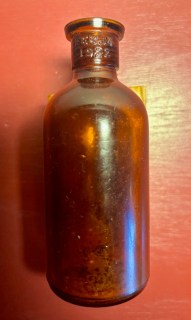
The subject bottle, manufactured to accommodate a threaded closure, is machine made and designed such that the threads needed to accommodate the closure are located inside the neck. The bottle is unembossed with the exception of the following patent information found on the neck directly below the lip.
MACH. PAT’D FEB. 14 1922


Almost certainly this refers to U.S. Patent No. 1,406,722 entitled “MACHINE FOR MAKING BOTTLES.” Assigned to the Spring Stopper Company of Brooklyn by Harry M. Brown, it was filed on March 18, 1918 and approved on the date embossed on the bottle, February 14, 1922. This description of the patented machine appeared in the May, 1922 edition of a publication called “The Glass Industry.”

So it’s apparent the bottle’s inside threaded finish was manufactured by a machine protected under this patent.
A March, 1927 advertisement run by the Spring Stopper Company and found in a trade publication called “The Glass Container,” sung the praises, of this bottle, calling it:
The only machine-made bottle with inside screw thread.

Another advertisement in “The Glass Container,” this one found in their April, 1930 edition, depicted a variety of seals and applicator rods offered in connection with this closure. The ad included their sales pitch which read in part:
An ethical pharmaceutical, a dainty toilet preparation – each requires a seal or applicator rod widely different in appearance and design.
Spring Stopper Seals and Applicator Rods are now offered in a wide variety of materials which give a selective choice to the manufacturer.
Seals are now available in glass. porcelain, Durez or Bakelite in colors. These seals screw into a thread which can easily be formed on the inside neck of your bottle. They make a perfect closure and reclosure. Now used by many nationally known companies, particularly for such difficult to seal products as hydrogen peroxide, camphorated oil, highly volatile substances.

The Spring Stopper Company, originally of Brooklyn, was organized in 1909 with the announcement appearing in the July 23rd edition of the “Brooklyn Daily Times.”
The Spring Stopper Company, of Brooklyn, has been organized with the State Department to manufacture bottles, jars, etc. The capital stock is placed at $10,000 consisting of shares of $100 each, and directors for the first year are Luke V. Lockwood of Greenwich, Conn.; Arthur J. Albert of Hoboken, and John T. Duane of Brooklyn.
The company was initially located at 81 Washington Street with Richard Canfield serving as both the president and sole stockholder. The company’s listing appeared in the 1913-1914 Copartnership and Corporation Directory of Brooklyn and Queens.
Spring Stopper Co. (NY) Richard A. Canfield, Pres.; Clayton F. McKenley Sec & Treas., Capital $10, 000., 81 Washington
Canfield passed away suddenly in December, 1914 when he fell, hitting his head on a staircase in a 14th Street station of the New York City subway. The following story published in the December 19, 1914 edition of the “New York Tribune” suggested that prior to his death, Canfield’s company had been accumulating patents in both the U. S. and Canada.
To the Spring Stopper Company, of which Canfield owned all the stock, is bequeathed all his American and Canadian patents, and all debts the company may owe him are cancelled. In payment for the patents the executor is instructed to cause the company to issue to himself sufficient stock to bring its capitalization up to $1,000,000. In this company stock to the value of $50,000 is given to Harry M. Brown, associated with him in its management; twenty-five thousand to his secretary, Clayton F. McKenley, and $25,000 to Thomas W. Sprague with the condition that they not dispose of it without offering it to the executor at a fair appraisal.
Two years later the capital had yet to be increased and was still sitting at $10,000 when, according to the July 16, 1916 edition of the “Brooklyn Citizen:”
John Hill Morgan, as referee, has recommended to the Supreme Court that Vincent Lockwood, executor of the estate of the late Richard A. Canfield, be allowed to invest $35,000 as working capital in the Spring Stopper Company.
The $10,000 capital stock of this company is owned by the estate. The device manufactured is a bottle stopper. Testimony given before the referee showed that Mr. Canfield had invested some $400,000 already in the concern which was about to begin operation when he died.
The additional $35,000 is necessary now to begin operations. Mr. Morgan was told Mr. Canfield intended to increase the capital to $1,000,000 and invest $250,000 as working capital. The referee decided that $35,000. might be invested.
Around the same time, the company moved to 217 Duffield Street in Brooklyn. At this point both Clayton F. McKenley and Harry M. Brown were still involved, McKenley apparently on the administrative and sales end and Brown on the technical end. In fact, between 1917 and 1920 Harry M. Brown obtained approval for at least four different patents, each of which involved bottle manufacturing machines and methods. Brown assigned each of the patents to the Spring Stopper Company.
No. 1,285429, Bottle Stoppering Machine, July 31, 1917; No. 1,292,243, Machine for Making Bottles, Jan. 21, 1919; 1,334,648; Machine Method for Making Carboys or Large Glass Containers1, Mar 23, 1920, and 1,346,528, Glass Serving Instrument, July 13, 1920.
Around 1920 the company moved across the East River to Manhattan where they listed an address of 220 Broadway with McKenley named as the company’s “representative” in the directories. Between 1920 and 1925, several more bottle related patents were obtained, including the patent dated February 14, 1922.
At least some of the company’s patents were associated with finishing machines that could be attached to various types of automated bottle making machines and, according to a November, 1925 story in a publication called the “American Perfumer & Essential Oil Review,” by then some of those patented finishing machines were built and operational.
The Spring Stopper Co. owns and controls machines which can be equipped to various types of bottle-making machines for making the inside screw finish, which it lets out on a royalty basis to bottle manufacturers. At present, the only company licensed to do this is the Salem Glass Works
The February 14, 1922 patent was certainly associated with one such machine.
The “American Perfumer & Essential Oil Review” story went on to say that at the time the Spring Stopper Company, now located at 165 Broadway, was promoting their business at the Sesquicentennial Exhibition in Philadelphia.
Spring Stopper Co., New York City, is one of the progressive exhibitors in the Sesqui-Centennial Exposition at Philadelphia in Building No. 2, near the Red Cross Booth. The exhibit has been a source of interest to visiting manufacturers in the toilet preparations and allied trades who have stopped to examine the large array of bottles of various sizes and shapes with the inside screw stopper shown by the company…

The booth was under the able direction of Miss Marie Martin, who explained to visitors that the reclosure bottle is produced as economically as ordinary bottles by an automatic machine process. Its various advantages were also explained.
The story identified the Salem Glass Works as the company licensed to manufacture bottles using the Spring Stopper Company’s patented machines, a fact confirmed by this November, 1926 advertisement found in “The Glass Container.”

The two companies apparently maintained a close relationship throughout the late 1920’s and early 1930’s, so much so that the Spring Stopper Company’s 1933 New York City directory listing specifically identified the company with the Salem, New Jersey location while simply listing a room number at their 165 Broadway address in Manhattan.
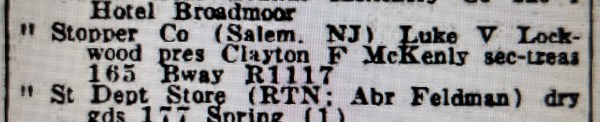
This all suggests 165 Broadway served as the company’s sales office while their finishing machines had been incorporated into the Salem Bottle Works operations.
It doesn’t appear that the Spring Stopper Company’s machine-made version of the inside threaded finish was all that successful. As far as I can tell, advertisements for the company and their finish vanish by the mid-1930’s and I don’t see many of their bottles advertised on e-bay. Additionally, in 20+ years on the bay I’ve only found the one pictured. That being said, as late as 1946 the Spring Stopper Company was listed in the NYC directories at 165 Broadway.
The subject bottle is approximately 5 inches tall and 1-3/4 inches in diameter. Brown in color, it gives the appearance of a pharmaceutical bottle.
An advertisement published in the May, 1929 edition of a publication called “Drug Markets” suggested it could have held a hydrogen peroxide brand called “MOONSHEEN,” manufactured by the Schuykill Chemical Company or a “Camphor Liniment,” manufactured by the H. E. Mulford Co.

Other advertisements, including this March 1927 advertisement in “The Glass Container,” also mention Parke Davis & Co. as a pharmaceutical client (lower left-hand side below) so that’s another possibility.


