
Louis Samilson was the sole proprietor of a small New York City based mineral water manufacturing and bottling company during the early to mid-1890’s. The company served as the predecessor for the Royal Bottling Company of Brooklyn, a business in operation up through the mid-1930’s.
Between 1891 and 1896, Samilson’s business was listed in the New York City directories with an address of 49 East Broadway in what is now known as the Chinatown section of Manhattan. During this time, according to New York State “Factory Inspection Reports” dated January 28, 1895 and January 27, 1896, his business employed five full time workers, all working a 60 hour week.
Sometime in late 1896 it appears that Samilson formed a partnership with Israel Levinson (sometimes Levison) and the business moved to 113 Sheriff Street where the mineral water business of Samilson & Levinson was listed in New York City’s 1897 Trow Business Directory. Not long afterwards Samilson disappeared from the New York City directories suggesting he left the business at around that time. What actually facilitated his departure is not clear and there’s no further mention of him that I can find.
Around the time Samilson disappeared it appears Levinson moved the bottling business to Brooklyn and began operating it under the Royal Bottling Company name. As early as 1898/1899 the Brooklyn Directory listed both Levinson (spelled Levison) and the Royal Bottling Company in Brooklyn at 470 Lafayette Avenue. That said, as early as October, 1897 a classified advertisement found in the October 31st edition of a New York City newspaper called “The World” puts the Royal Bottling Company at that address.

Still a small operation, the New York State “Factory Inspection Report,” dated January 28, 1901 identified only three full time workers at the Lafayette Avenue facility, all working a 60 hour week.
Sometime in 1901 or 1902 the business moved to 531 Waverly Avenue and in November, 1902 it incorporated under the “Royal Bottling Company,” name. The incorporation notice appeared in the November 7th edition of Brooklyn’s “Daily Times.”

Shortly afterwards, the company’s “bottling notice” was published in the November/December, 1902 editions of several Brooklyn newspapers. Now using bottles embossed with the “Royal Bottling Company,”name, the notice indicates that at the time they were also still using some older bottles embossed with the Samilson name.

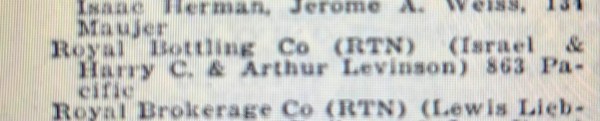
The company remained at their Waverly Avenue location until sometime in the early teens when they moved to what would become their long-time home at 863 Pacific Street. The 1913/1914 Copartnership and Corporation Directory of Brooklyn and Queens listed the company at that address, naming Israel Levinson as the company’s only principal.

Apparently a family affair, by 1922 sons Arthur and Harry had joined the business as well.
As far as I can tell the specialty of the business was their Royal Ginger Ale that according to a series of 1911 advertisements was:
The leading capped Ginger Ale, used in all fancy clubs and hotels.

The advertisements, found in several July editions of a Brooklyn newspaper called “The Weekly Chat.” were run by a large New York City grocery business called H. C. Bohack & Co. so the ginger ale was certainly being marketed for home use as well.
Later, the company apparently changed the brand name to the “Manhattan Dry Pale Ginger Ale.” Their June 11, 1925 patent application stated that the name change occurred in March of that year.

Over the next few years, taking full advantage of National Prohibition, their “Manhattan Dry Pale Ginger Ale” continued to be associated with hotels, nightclubs and restaurants. One such hotel was the Beau Rivage in Sheepshead Bay.

According to the fine print at the bottom of the August 10, 1928 “Brooklyn Daily Eagle” advertisement pictured above, the ginger ale was one of several products that contributed to the hotel’s success.

Not just a summer drink, a night club called the “Open Fireplace” on Brooklyn’s Joralemon Street, included it as part of their Christmas and New Year’s Day dinners as well as their New Year’s Eve Party.

Likely not a coincidence, several years after the repeal of National Prohibition the Royal Bottling Company came to an official end when on September 11, 1936 the “Brooklyn Citizen” announced that the company’s assets were being auctioned off for the benefit of their creditors.
ASSIGNEE SALES
SUPREME COURT, KINGS COUNTY
In the matter of the general assignment for the benefit of creditors of Royal Bottling Co., Inc. assignor, to Maurice S. Levy, assignee.
Please take notice that the undersigned will sell at public auction through SHIELDS & GUTTERMAN, auctioneers, on Wednesday, September 16, 1936 at 10:20 a.m., at 285 Jay Street, in the Borough of Brooklyn, City and State of New York, the assets of the above named assignor consisting of bottles, merchandise, machinery, office furnishings, etc.
MAURICE LEVY, Assignee.
Six months earlier, the March 31, 1936 edition of the “Brooklyn Daily Eagle” announced that their long-time home at 863 Pacific Street was being renovated and leased to another business.
Bulkley & Horton Company, through A. Cardinale, of its Lafayette Ave. office, leased the two-story and basement brick garage and loft building at 863 Pacific St., on a lot 25×100 for a term of three years to the Safe Breath products Company, which will occupy it after extensive alterations are completed.
According to streeteasy.com the building located at 863 Pacific Street today was built in 1930, however, recognizing that the Royal Bottling Company listed 863 Pacific Street as their address before, during and after 1930 suggests it was built earlier. This photo of the building, courtesy of Google Maps, certainly fits the above description of the building the company occupied.

The bottle I found is in bad shape, lacking its base. That said it was certainly pony shaped and exhibits a tooled blob finish. Embossed with the L. Samilson name and 49 East Broadway address it dates to the roughly five year period from 1891 to 1896 when Louis Samilson served as the proprietor at that address. Recognizing Levinson continued to use the Samilson embossed bottles for several years after establishing the Royal Bottling Company the bottle may not have made its way to the Long Island bays until the early 1900’s.